Source: St. Martin’s Press
Hardcover, 356 pgs.
I am an Amazon Affiliate
The One That Got Away by Melissa Pimentel is loosely based on Jane Austen’s Persuasion. Ruby Atlas is a tough young woman making her career in advertising on her own, while Ethan Bailey is a young, handsome billionaire who made a revolutionary app. It has been 10 years since they’ve seen each other when they broke up. Ruby is filled with anxiety at the reunion because she harbors a terrible secret about why she broke up with him after a wonderful summer of love. Like Persuasion, Ethan (our modern Frederick Wentworth) is barely in the novel with many of his appearances happening in the past. The novel alternates points of view between Ethan and Ruby and between the present and the past.
Both have lost their mothers — Ethan’s mother ran off and Ruby’s mother died when she was a young girl. When her sister Piper decides to marry Charlie, Ethan’s best friend, neither one can avoid the inevitable, being once again in close proximity. Ethan is a quiet and passionate man, and his dark handsome looks and big bank account make him a bit target at Piper’s wedding, and Ruby is incredibly jealous. It’s at the wedding that she realizes she never stopped loving Ethan.
Pimentel’s characters are all incredibly nice and adult, though there are a few moments of female jealousy (tame at best). There are some fantastic turns of phrase and bits of humor as well.
“We were rebranding them as the ‘Airline of Adventure,’ complete with GoPro footage of various lunatics jumping off buildings and abseiling down crevasses. Because surely, at this point, it was only those lunatics who would willingly board one of their rickety planes.” (pg. 3)
“…she would sit upright and alert, like a gopher peering up and out of its hole.” (pg. 208)
This was the perfect summer read. I enjoyed traveling to Europe with Ruby’s family and friends, and seeing Ethan and Ruby navigate their reunion with kid gloves. There are Austenesque misunderstandings between them, and of course, there is the healing of Ruby who has been lost for the last decade.
“I had forced myself to love that place for so long. The idea that I didn’t belong there — that I couldn’t belong — had been so crippling that I’d molded myself into someone who did belong, sharpening my elbows and edges every morning before I left the house.” (pg. 348)
The One That Got Away by Melissa Pimentel is about a young woman who strove to make it in the Big Apple because it was the last memories she had of her mother, and because of her independence, she molded herself to a life that left her less than satisfied. But it is equally about the enduring rock of love where you can break yourself against it like Ethan and Ruby or embrace its strength and move forward together. Pimentel had my attention from page one this summer, and the novel was more than satisfying.
RATING: Quatrain

Photo Credit: Ryan Bowman
About the Author:
MELISSA PIMENTEL grew up in a small town in Massachusetts in a house without cable and therefore much of her childhood was spent watching 1970s British comedy on public television. These days, she spends much of her time reading in the various pubs of Stoke Newington and engaging in a long-standing emotional feud with their disgruntled cat, Welles. She works in publishing and is also the author of Love by the Book. Visit her on Twitter and on Facebook.
New Authors Reading Challenge 2017


 Today’s guest, Alexa Adams, and I’m particularly happy to say I got to stretch my poetry skills and help her modify some of the poems in her latest
  Isaac Watts (1674-1748), known as “The Father of English Hymnody” (despite his nonconformist faith), was a prolific writer and English minister. Many of his hymns remain in use today, and he is credited with ushering in a new era of English hymnody, one based on original poetry instead of biblical psalms (though his most famous, Joy to the World, is based on Psalm 98). His poem “Against Idleness and Mischief” from Divine Songs for Children was particularly famous in its day. It is not just referenced by Carroll, but also makes an appearance in Charles Dickens’s David Copperfield.
 Carroll is quite clever in turning a poem about industry and the dangers of idleness into an exotic tale of a languid creature, intuitively going about its business of feeding on its prey. His mockery of Watts’s didactic purpose beautifully suits the overall absurdity of Wonderland, where all morality and natural law is entirely turned on its head. Following in his path, I chose to make my parody a tribute to Lady Bertram of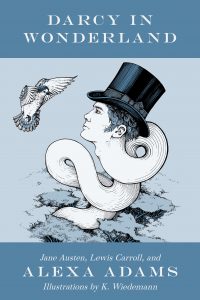

 Source: QuartoKnows

 My Dear Sophy by Kimberly Truesdale, a Kindle freebie.
 Pride and Persistence by Jeanna Ellsworth, a Kindle freebie.
 The Young Phantom by David Coward, a Kindle freebie.
 Stubborn by Heather C. Myers, a Kindle freebie.
 Gardening 101: Friendship Gardens by Henry Owen and Katherine Metzo, a Kidle freebie.




 Source: Quarto Books

 Source: Mary Bisbee-Beek
 About the Poet:

 The One That Got Away by Melissa Pimentel for review.
 Source: Media Masters Publicity