Quantcast

Creating Our Own Fibonacci Poem…


Click the image for today’s National Poetry Month blog tour post!

This month has been chock full of poetry from reviews of Neruda to a vlog reading of a poem by Maya Angelou, but some of my favorites have been the creation of poetry. A few Fridays ago, we created a taboo poem without using certain words, and that community project turned out so well, I thought we’d try another one.

So today, I turn to you for the creation of a Fibonacci poem. Tabatha Yeatts explained it best, and for this exercise, each one of you only needs to contribute a line of the appropriate word length.

Typically, the sequence involves adding the previous two numbers together so that the sequence looks like this 1-1-2-3-5-8, and it can go beyond these 6 lines.

I’ll start the poem with this word in line 1:

Rascals

So the next line should have one word, and then the following line should have 2 words, etc., down the line.

Ok, get to it and have fun!
My Blackout Poem

Click the image above for today’s National Poetry Month Tour stop!

On Friday, I posted an activity in which everyone could create their own poem using the Blackout Poem method. While I didn’t have time to find a paper article and take a photo, I did the next best thing and took the article I posted from The New York Times and crossed our the words I didn’t want and made the ones I wanted bold blue.

Here’s the result, and I hope you’ll share yours!

THE Chilean poet Pablo Neruda, known for his love poems and leftist ideals, died 40 years ago this September. One would hope he’d be at rest by now. But on Monday, as classical musicians played a Neruda work set to music by Vicente Bianchi, his remains were exhumed to determine whether he died from poison — instead of prostate cancer, the conventional account.

In recent years, other icons of the Hispanic world have suffered the same fate. In 2011, Salvador Allende, Chile’s democratically elected president-elect who was deposed by a military junta in 1973, was disinterred to verify that he’d fatally shot himself. (The finding — yes — is still disputed.) The late Venezuelan president Hugo Chávez ordered in 2010 that the tomb of his idol, Simón Bolívar, be opened to test his theory that the liberator died of poisoning, not tuberculosis. (The theory remains unproved.)

And in 2008, a Spanish judge authorized the unearthing of a mass grave in the southern town of Alfácar to see whether Federico García Lorca, the poet and dramatist who was assassinated by Fascists in 1936, at the outset of the Civil War, was buried there. (The results were inconclusive.)

There is something gothic, but also cathartic, about summoning artists like Neruda, and his close friend García Lorca, back into the realm of the living, making us wonder if death is really the end. A Chilean judge’s decision, in February, to allow an investigation into Neruda’s death, which led to this week’s exhumation, looks like an act of expiation.

Neruda used his pen to denote, to denounce, to decry. He was 69 when the junta took power. By then he had been an embassy attaché, a senator and an ambassador. In 1969, he initially ran for president as a Communist, but later backed Allende’s candidacy. However, passion for political change was only one side of his persona. The other was that of a bon vivant. Many people enjoy life plentifully, but few have been so eloquent about it. The Dionysian sensuality of Neruda’s odes is contagious, joyful and erotic. And also destructive: Neruda’s marriage to Matilde Urrutia, his third wife and the inspiration for “The Captain’s Verses” and “One Hundred Love Sonnets,” unraveled after she learned he was having an affair with her niece.

Neruda died in a clinic in Santiago on Sept. 23, 1973 — 12 days after the American-backed coup that overthrew Allende and brought Gen. Augusto Pinochet to power. Many Chileans have long been skeptical of the official cause of death. In 2011, Neruda’s former driver said the poet told him, on the eve of his death, that he’d been given a harmful injection by a doctor. Conspiracy theorists note that Neruda died in the same hospital where Eduardo Frei Montalva, a politician who had supported the junta before switching sides, died in 1982. A judge ruled in 2009 that Frei had been poisoned.

Could Neruda have suffered a similar fate? Allende had died on Sept. 11, 1973, and another opponent of the junta, the folk singer Víctor Jara, was assassinated on Sept. 16. Finishing off Neruda could have been the junta’s coup de grâce.

Exhuming icons is one way to deal with guilt. Elsewhere in Latin America, the past’s phantoms are resurfacing: in Guatemala, where the former dictator Efraín Ríos Montt is on trial for genocide; in Argentina, whose cities are dotted with memorials to those who were “disappeared” during the “dirty war”; and in Mexico, where a once-pliant media have challenged the former president Felipe Calderón’s handling of the war against drug cartels.

But Neruda holds a special place in this grim look backward. Gabriel García Márquez, the Colombian writer and a fellow Nobel laureate, has called him “the most important poet of the 20th century — in any language.”

Neruda left thousands of poems, a handful of which are of such inspired beauty as to justify the very existence of the Spanish language. Adolescents routinely give his “Twenty Love Poems and a Song of Despair” to their sweethearts. His ideological verses have been read aloud, often from memory, in one revolution after another, from the fall of the Berlin Wall to the embers of the Arab Spring. Some of Neruda’s poems — “I Ask for Silence,” “Walking Around,” “Ode to the Artichoke” — have been rendered into English repeatedly, each version another effort to make him current and vital to a new generation.

Make Your Own Blackout Poem…Activity for You

Please click the image above for today’s National Poetry Month Tour stop!

For today’s activity, I thought it would be fun to take a newspaper article and create a blackout poem.

What you do is get a newspaper article, and cross out the words that don’t move you in some way in each line of text with a sharpie.  You can leave behind one word, two words, none, if you wish.  The final result should be the lines for a poem.

For an idea of how this is executed, please refer to Picky Girl’s tour stop this week.

There are three ways to participate:

  1. Find a paper article and cut it out from the paper and blackout the words, come back to the blog and share your article title, newspaper source, and the poem you created.
  2. Find a newspaper article, blackout the words, create your own blog post and share an image of your blackout poem.
  3. Use the article I’m re-posting here from The New York Times, black out the words, and leave your poem in the comments.

Here’s the New York Times article:

THE Chilean poet Pablo Neruda, known for his love poems and leftist ideals, died 40 years ago this September. One would hope he’d be at rest by now. But on Monday, as classical musicians played a Neruda work set to music by Vicente Bianchi, his remains were exhumed to determine whether he died from poison — instead of prostate cancer, the conventional account.

In recent years, other icons of the Hispanic world have suffered the same fate. In 2011, Salvador Allende, Chile’s democratically elected president-elect who was deposed by a military junta in 1973, was disinterred to verify that he’d fatally shot himself. (The finding — yes — is still disputed.) The late Venezuelan president Hugo Chávez ordered in 2010 that the tomb of his idol, Simón Bolívar, be opened to test his theory that the liberator died of poisoning, not tuberculosis. (The theory remains unproved.)

And in 2008, a Spanish judge authorized the unearthing of a mass grave in the southern town of Alfácar to see whether Federico García Lorca, the poet and dramatist who was assassinated by Fascists in 1936, at the outset of the Civil War, was buried there. (The results were inconclusive.)

There is something gothic, but also cathartic, about summoning artists like Neruda, and his close friend García Lorca, back into the realm of the living, making us wonder if death is really the end. A Chilean judge’s decision, in February, to allow an investigation into Neruda’s death, which led to this week’s exhumation, looks like an act of expiation.

Neruda used his pen to denote, to denounce, to decry. He was 69 when the junta took power. By then he had been an embassy attaché, a senator and an ambassador. In 1969, he initially ran for president as a Communist, but later backed Allende’s candidacy. However, passion for political change was only one side of his persona. The other was that of a bon vivant. Many people enjoy life plentifully, but few have been so eloquent about it. The Dionysian sensuality of Neruda’s odes is contagious, joyful and erotic. And also destructive: Neruda’s marriage to Matilde Urrutia, his third wife and the inspiration for “The Captain’s Verses” and “One Hundred Love Sonnets,” unraveled after she learned he was having an affair with her niece.

Neruda died in a clinic in Santiago on Sept. 23, 1973 — 12 days after the American-backed coup that overthrew Allende and brought Gen. Augusto Pinochet to power. Many Chileans have long been skeptical of the official cause of death. In 2011, Neruda’s former driver said the poet told him, on the eve of his death, that he’d been given a harmful injection by a doctor. Conspiracy theorists note that Neruda died in the same hospital where Eduardo Frei Montalva, a politician who had supported the junta before switching sides, died in 1982. A judge ruled in 2009 that Frei had been poisoned.

Could Neruda have suffered a similar fate? Allende had died on Sept. 11, 1973, and another opponent of the junta, the folk singer Víctor Jara, was assassinated on Sept. 16. Finishing off Neruda could have been the junta’s coup de grâce.

Exhuming icons is one way to deal with guilt. Elsewhere in Latin America, the past’s phantoms are resurfacing: in Guatemala, where the former dictator Efraín Ríos Montt is on trial for genocide; in Argentina, whose cities are dotted with memorials to those who were “disappeared” during the “dirty war”; and in Mexico, where a once-pliant media have challenged the former president Felipe Calderón’s handling of the war against drug cartels.

But Neruda holds a special place in this grim look backward. Gabriel García Márquez, the Colombian writer and a fellow Nobel laureate, has called him “the most important poet of the 20th century — in any language.”

Neruda left thousands of poems, a handful of which are of such inspired beauty as to justify the very existence of the Spanish language. Adolescents routinely give his “Twenty Love Poems and a Song of Despair” to their sweethearts. His ideological verses have been read aloud, often from memory, in one revolution after another, from the fall of the Berlin Wall to the embers of the Arab Spring. Some of Neruda’s poems — “I Ask for Silence,” “Walking Around,” “Ode to the Artichoke” — have been rendered into English repeatedly, each version another effort to make him current and vital to a new generation.

A statute of limitations, along with the likelihood that culpable figures are dead, make an authoritative verdict on Neruda’s death improbable. The exhumation is creepy. The Pablo Neruda Foundation, the poet’s literary executor, initially did not support it, and his nephew and biographer remains skeptical. The decision, which followed a request by Chilean Communists, seems motivated more than anything by a present-day desire to bury the past by, paradoxically, digging it up. It’s largely pointless: The demonization of Pinochet is well under way — see, most recently, Pablo Larraín’s film “No,” about the 1988 plebiscite that helped end his rule.

Neruda, it seems to me, is beyond such trifles. He is the poet of the eternal present. He revealed to us the best antidote to oppression (and its most noxious companion, oblivion): poetry.

On its surface, a poem seems incapable of stopping a bullet. Yet Chile’s transition to democracy was facilitated by the poet’s survival in people’s minds, his lines repeated time and again, as a form of subversion. Life cannot be repressed, he whispered in everyone’s ears. It was a message for which he may have died, but that lives on in his verse.

The best thing to do is just have fun; don’t think about creating a poem!

The Taboo Poem Revealed

Click the image for today’s National Poetry Month Tour stop!

Last Friday, I challenged my readers to comment with one line of poetry about romance, without using that word or five others — LOVE, BURNING, PASSION, SWEET, HEART.

I’ve given it a tentative title, but the rest was your creation:

First Sight, Love

Can we defy expectations, and have this part never end?
winding around me like ivy
gently pushing through the wall i built up
Stealthy, unexpected, brilliant, bright. The surprise of a star, a first kiss
yearning for your touch
the bliss of a kiss…
Words spoken, yet
nothing said, glances
lock, then lost
The promise of promises yet to come

Thanks to the following for their contributions:

Rhapsody in Books
Necromancy Never Pays
Diary of an Eccentric
Unabridged Chick
So Many Books
Peeking Between the Pages
Parrish Lantern
Worducopia

Poetry Is Dead, Or So They Tell Me

Please pop on over to today’s tour stop for National Poetry Month by clicking the image.

As with any opinion piece I read these days, I always ask myself who the writer is and what’s the agenda. In the case of Joseph Epstein, I find that many of his previous essays are meant to stir discussion and anger from certain groups, enough for them to take action (i.e. his homosexual essay, for one).

His recent opinion piece in the Wall Street Journal (subscription required) about the death of contemporary poetry, he essentially says that it only matters to those who write it and continue to publish it, no matter how bad it is. What I find comical is his statement, “We still have people playing the role of major poets, but only because the world seems to require a few people to play the role.” Why, if poetry is dead and no longer wanted, would society need people to “play” the role of poet?

I also question his argument that poetry is not relevant or wanted by society because it cannot be quoted; “But if I ask a literary gent or lady to quote me a single line or phrase from any of our putative major poets, they cannot do it.” If reiterating lines, simply for the sake of rote performance is the key to love of literature, then I want no part of it. I prefer to be impacted by poetry and literature; I want the words, the images, the situations, and anything else in the piece to speak to me, to change my mind, to make me think and feel something outside of my daily routine … in a way to transcend beyond myself into a more universal space of understanding.  (see other rebuttals, if you subscribe to Wall Street Journal).

He goes on to discuss contemporary poetry failing to do what poetry did long ago — resonate and elevate. Clearly, he has not been reading Yusef Komunyakkaa, Mary Oliver, Ted Kooser, Natasha Trethewey, Jehanne Dubrow, Sweta Vikram, and many others. He admits as much when he says he cannot remember the last time he bought a contemporary poetry collection. I can! Bernadette Geyer’s The Scabbard of Her Throat in March.  I can remember when I received my last collection, Jehanne Dubrow’s Red Army Red, from friends who know my love of poetry and choose well. If you don’t read it, how will you find those poets and poems that sing to you?

You’ll likely not be surprised that this is Epstein’s second essay on the death of poetry (“Who Killed Poetry?” was the first). Why does he write so many essays on this topic if the genre has been long deceased? Probably because he wishes it were, and yet, it thrives.

Taboo Poetry…A Game

Be sure to click the image above for today’s tour stop on the National Poetry Month Blog Tour!

Have you ever played that early 1990’s game Taboo from Hasbro?  Today, I would invite you all to play along with me as we create a poem in the comments in celebration of National Poetry Month.

The object of the game here is to create a poem about the word below, without referring to that word or any of the other 5 words that are most used to describe it.

The word is ROMANCE

And the forbidden words (and their variations) are:  LOVE, BURNING, PASSION, SWEET, HEART

So each commenter can write one line for the poem that describes ROMANCE, but does not use that word or the five forbidden words.

At the end of the day, I’ll collect all the lines and post the full poem next week; It’ll be fun to see what all the creative minds out there can come up with.

OK, Get started!

Poetry as Gold. . .

Welcome to the Savvy Verse & Wit blog tour for National Poetry Month in the United States, but here on the blog, I consider it more of an international celebration.

If you have signed up to celebrate poetry this month, there are still some dates open, just check the schedule and let me know what date you’d prefer.

This past week I was reading Night Train to Lisbon by Pascal Mercier, translated by Barbara Harshav, and I came across a commentary about recreating the Portuguese language to make it clearer and truer to its origins: “The waiter, the barber, the conductor — they would be puzzled if they heard the newly set words and their amazement would refer to the beauty of the sentence, a beauty that would be nothing by the gleam of their clarity. … At the same time, they would be without exaggeration and without pomposity, precise and so laconic that you couldn’t take away one single word, one single comma. Thus they would be like a poem, plaited by a goldsmith of words.” (page 26) This passage reminded me of how poets — and fiction writers — often seek out ways through language to make images, characters, situations, emotions, and more clear to the reader — drawing connections between images that may, at first, seem to have nothing to do with one another, but through a juxtaposition or other means provide the reader with some insight or generate within him or her a deeper understanding or emotional response.

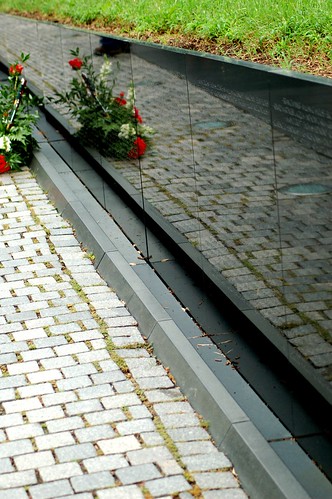
As I’m sure many of my faithful readers know, I read and write poetry, but they probably also know that I love Yusef Komunyakaa‘s work in particular.  “Facing It” is one of my all time favorites, and I think part of it is because I can picture exactly what he’s seeing as the Vietnam veteran in the poem describes his first experience with the Vietnam War Memorial.

Facing It

My black face fades,   
hiding inside the black granite.   
I said I wouldn't  
dammit: No tears.   
I'm stone. I'm flesh.   
My clouded reflection eyes me   
like a bird of prey, the profile of night   
slanted against morning. I turn   
this way—the stone lets me go.   
I turn that way—I'm inside   
the Vietnam Veterans Memorial
again, depending on the light   
to make a difference.   
I go down the 58,022 names,   
half-expecting to find   
my own in letters like smoke.   
I touch the name Andrew Johnson;   
I see the booby trap's white flash.   
Names shimmer on a woman's blouse   
but when she walks away   
the names stay on the wall.   
Brushstrokes flash, a red bird's   
wings cutting across my stare.   
The sky. A plane in the sky.   
A white vet's image floats   
closer to me, then his pale eyes   
look through mine. I'm a window.   
He's lost his right arm   
inside the stone. In the black mirror   
a woman’s trying to erase names:   
No, she's brushing a boy's hair.

In particular, I love the parts of the poem where he describes reflections in unique ways, especially when the reflection eyes him like a bird of prey and the names that “shimmer on a woman’s blouse” but remain on the wall as she walks away. In addition, the poem reflects on the practice of rubbing the names onto paper from the wall as a form of care and caress — “she’s brushing a boy’s hair.”

Sorrow 2 -- Vietnam Wall

In many ways, poetry not only tells stories, but creates them with their readers and generates an emotional response that can be carried over to friends, families, or even book clubs. These are the types of poems that I consider “gold.”

What makes a great poem for you?

Book News: 2013 Gaithersburg Book Festival and More

The Gaithersburg Book Festival — this year on Saturday, May 18, 2013 — started out as a small gathering with local vendors and authors that has grown over the years to include some nationally recognized names.

The 12 finalists for the teen short story contest the festival holds have been selected, and their pieces will be judged this year by best-selling novelist, Caroline Leavitt.  If you want to check out the entries, go here.  But fear not, there are things for adults as well, including writing workshops sponsored by The Writer’s Center in Bethesda, Md., and those workshops will take up to 20 students beginning with sign-ups on the day of the festival.

I’m really looking forward to meeting Tara Conklin, author of The House Girl (my review), in person.  And everyone has been raving about The Crooked Branch by Jeanine Cummins, and she will be there … not to mention Tatjana Soli has a new book out, The Forgetting Tree, and I just loved her book The Lotus Eaters.  The list of authors is growing daily, and I really hope that Beth Kephart is one of them, but I haven’t heard one way or another and I know she’s incredibly busy.  In terms of poetry, Sarah Arvio will be there as well.  This year’s festival is shaping up to be another wonderful event, thanks to the hard-working volunteers and the city of Gaithersburg.

The 2013 National Poetry Month Blog Tour is upon us. I hope that everyone will take the chance to check out the schedule and offer up a favorite poem, poetry of their own, or poetry vlogs/vidoes and collection reviews during April.

I’m really looking forward to the tour stops that are already scheduled, but I would love to see some more blogs sign up. April 5, 7, 11, 13, 15 are free at the beginning of the tour and I would love to see some volunteers for those dates. Just drop me a comment or an email about what date you’d like.

Thanks to everyone who has signed up thus far. It is much appreciated.

I hope everyone has a great weekend, and please do share any book-related news you are excited about.

National Poetry Month Blog Tour Calendar for April 2013

Welcome to the National Poetry Month Blog Tour Event Calendar as it currently stands.  I’d like to fill in all the dates, so please leave a comment or fill out the form to join the fun.

April 1:  Savvy Verse & Wit Kick-Off

April 2: Things Mean a Lot

April 3:  MaggieMaeIJustSayThis

April 4:  Necromancy Never Pays

April 5:  Regular Rumination

April 6:  Booking Mama

April 7: Rhapsody in Books

April 8:  Maximum Exposure

April 9:  The Picky Girl

April 10: Tabatha Yeatts

April 11:  Book Snob

April 12:  Peeking Between the Pages

April 13:  The Betty and Boo Chronicles

April 14:  Rhapsody in Books

April 15: My Juicy Little Universe and Life’s A Stage

April 16:  Lost In Books

April 17: Diary of an Eccentric

April 18:  Still Unfinished

April 19:  Wordy Evidence of the Fact

April 20:  Bermudaonion Weblog

April 21:  Insatiable Booksluts

April 22: Ad Astra (To the Stars)

April 23:  So Many Books

April 24:  Lit and Life

April 25:  A Bookish Way of Life

April 26: Life’s a Stage

April 27:  Insatiable Booksluts

April 28:  The Indextrious Reader

April 29:  Pen Paper Pad at Savvy Verse & Wit

April 30:  Worducopia


2013 National Poetry Month Blog Tour Sign-Ups

2013 National Poetry Month Blog Tour

Welcome to the sign ups for the 2013 National Poetry Month blog tour. Everyone is invited to share poetry in April either through the tour, on your own, or just hop on the tour and discussions at any time throughout the month with spotlights on poets, reviews of poetry books, event information about poetry readings, your own poems, and more.

If you cannot see the form, please use this link.

AWP 2013 Boston

Although I’m still working on a poetry manuscript and it’s taking me longer than expected, I wanted to take the time to attend the big writer’s conference for two reasons:

  1. It was in Boston, which I miss
  2. I’ve never been to a conference of this size with so many writers and I wanted to see what other people were doing and how they coped with time management and other issues.

Registration opened on Wed., March 6, and I had planned to get my registration and spend the day with my hubby in Boston, while the little one was watched by her grandparents. While I did pick up my conference badge, etc. and we did get to have a lunch at an Irish pub, Sólás, that had phenomenal smoked Gouda and bacon fondue and some great chowda and soup!  Unfortunately, that’s when we got the call that the little one was running a fever and was not eating, etc.  Let’s just say that the plan to go out and about and take photos and just explore did not happen as I had expected and we headed home.  And this was a continued issue for me throughout the remainder of the week — worry over the kiddo and balancing that with the conference that I paid for, plus a lovely blizzard!

Thurs., March 7:

My first panel was “Revival of the Literary Salon with the Cambridge Writer’s Workshop” with Jessica Piazza (whom I’ve interviewed for 32 Poems), Rita Banerjee, Diana Norma Szokolyai, Samantha Milowsky, and Jade Sylvan), which was fun.  We learned about the creation of literary salons or writing groups that mix genres and music or more to experiment with form and just have fun.  It is less about critiquing work outright and more about learning and sharing with others.  A fun environment in which to share work that may be in draft form or that may be hard to finish for some reason, etc.  It can help provide feedback without being formal.  This panel ended with a writing exercise, similar to the game of Taboo, in which groups were randomly formed to write about an object in poetry from without using a certain list of words.  My group’s poem was not as good as the others in my self-critical opinion, but I confess, I’m not really a morning writer and this was the 9 a.m. panel.  I also felt for a long time like the most “normal” person in the room, and I’m far from normal.

I did end up missing 3 panels — “Keeping Track of Your Book,” “Sources of Inspiration” with Matthew Pearl and “The First Five Pages: Literary Agents and Editors Talk” — because I decided to meet with Sweta Srivastava Vikram at her publisher’s booth, Modern History Press, for a chat that turned into a 2 hour lunch!  Sweta is as lovely and honest in person as she is online, and I really love that about her.  You can check out an impromptu photo with one of her other poet friends, Rajiv Mohabir, here on Facebook.  We had such a great discussion of personalities online and offline and how disingenuous it seems when people have separate personas online and off, as well as a discussion about pulling back from friends in need because they seem to always be in need, etc.  Was a great discussion of chowda and lobster bisque!

The second panel I attended, “What a Novella Is,” was moderated by my friend K.E. Semmel, and touched upon the hardships of writing and defining a piece of work.  The panelists talked about how difficult it is to define novella beyond a simple word count, but most agreed that there is a single line of story but that it goes deeper than a short story would.  There were questions from the audience about Novella and it was discussed that writers need to take a hard look at their longer pieces to see if it is a novel in progress or a short story with too much excess before deciding its a novella.  There were some great novella recommendations from the panel, including one of my recent favorites — We the Animals by Justin Torres.  For a more in depth recap, please check out Melville House.  For this panel, I missed these panels “Lady Lazarus and Beyond: The Craft of Sylvia Plath,” “Writing the Great Hunger,” and “Literary Boston: A Living History” — I think it would be great to split panels up between friends and compare notes, since so many panels are at the same time in different rooms.

“The Chapbook as Gateway” panel with B.K. Fischer, Stephanie Lenox, Lyrae Van Clief-Stefanon, Susanna H. Case, and David Tucker was interesting and discussed how poets can use chapbooks as a limited edition to gain audiences and readers before a first book comes out, like a preview to greater work to come.  It was touted as a possible marketing tool at readings, with poets remarking on how many copies are available in the limited edition chapbooks and that only those readers acting quickly will have the gem.  It was interesting to note that some of the poets also have published other chapbooks even since their first book and that they find they like the form as a way to reach new readers at readings and to fill in the gaps between books.  Unfortunately,this panel was at the same time as “Does Place Still Matter,” a panel with Stewart O’Nan.

“Women Poets on Mentoring” with Allison Joseph, Rebecca Dunham, Brittany Cavallaro, Shara McCallum, and Tyler Mills was an excellent panel to end the day with and circled back to the earlier discussion Sweta and I had over lunch.  Each talked about their mentee-mentor relationship and the differences between it with their advisor-advisee relationship.  It was very engaging and it was clear that the relationships between these women were mutually beneficial.  However, there were questions from the audience about how to find mentors if you are not in a college or graduate program, and the women suggested writing programs at local centers, connecting with favorite authors through letters or email and even online, and just attending events, though they cautioned that pushing work and reviewing work early on in the relationship is not advised.  The panel also talked about how to balance the mentor-mentee relationship with other obligations, like jobs and family.

After this panel, I headed home and missed the keynote with Derek Walcott and Seamus Heaney, even though I really wanted to attend.  There was a big time gap between the panel and the keynote and my daughter had a fever and was feeling poorly, so I headed home.

Friday, March 8‘s blizzard hit my parents area harder than Boston, so we received a lovely 22 inches of snow and getting to Boston was going to be difficult, so I chose to miss all the panels I had prioritized and wanted to see more than the others in the schedule (including Fred Marchant’s panel on his 20th anniversary of his first book, etc.) to care for my still sick daughter.  She slept a great many hours on my lap throughout the day.

Sat., March 9:

I chatted with Sweta when I arrived at the bookfair (which is an overwhelming 3+ rooms) and met a couple poet friends of her throughout our chats.  After out morning chat and a couple of stops around the bookfair, I headed to the “Lower Your Standards: WIlliam Stafford in the Workshop” panel with Fred Marchant, James Armstrong, Phillip Metres, Alissa Nutting, and Jeff Gundy.  Jeff Gundy and Alissa Nutting were hilarious, with one of them talking about their own first workshop experience and being half-naked in the bathroom crying even though they had no reason to pee.  It seemed that some of the panelists knew Stafford well when he was alive and they talked about his workshop philosophy and his hands off style of teaching, as well as his negativity toward grading and even praising students as too much guidance, etc.  It was a good panel about guiding writers in their process and remaining less focused on an outcome/finished product.  I did miss a panel with Yusef Komunyakaa for this panel about “Breaking the Jaws of Silence,”

“Bringing Poetry to the People” with Taylor Mali, Samantha Thornhill, Jon Sands, Roger Bonair-Agard, and Michael Salinger was a great panel about how to get poetry out to the community, but it also was more about providing those with stories to tell a way in which they can tell those stories that is accessible.  There were several programs that focused on needle-exchange programs and prisoners and how to get those people to write poetry as a way to cope, etc.  While inspiring, those are not things I could see myself doing, but I’d be interested in supporting those programs for sure because some of the poems these people shared from the participants were emotionally jarring and moving.  PopUpPoets showed a video of breaking down walls among commuters etc. as each poet boards a train, for instance, and stands up to begin reading poetry, and sits down before another stands up in a sort of round robin.  As someone who is incredibly nervous reading in public, this also is not for me, but I really love the idea of getting poetry greater exposure among the general public!

I checked out the rest of the bookfair and met up again with Sweta, who was my buddy this conference.  I felt like a zombie at this point and some of the people walking around the book fair seemed like zombies as well.

My final panel, “Master of None: Surviving and Thriving Without an MFA,” with Ru Freeman (loved Disobedient Girl), Rebecca Makkai, Samuel Park, Marie Myung-Ok Lee, Ida Haffermer-Higgins, has given me hope that I won’t have to incur a lot of debt to get a book published or find an agent, if I get a novel done and need one.  Unless I’m interested in teaching or embarking on another profession, I have no need for an MFA unless like someone in the audience said, “I need a structured program to sit down an write.”  I love that the women on this panel are balancing family and other jobs, and though it is sad to see that they have to hold down other jobs to make ends meet and that they cannot simply write all day, Ru Freeman was witty with her quips.  She even pointed out that big publishers certainly make a ton off of the books they publish when Samuel Park said that the editors no longer edit but have other jobs and duties that they fulfill off the clock.  Freeman also said that she finds men tend to have more time to write than women who are juggling full-time jobs and family obligations, but some male audience members wonder if that’s true for all men.  I’m sure she didn’t mean all men and was just making an observation based on her experiences.

Like most other people, I left the conference after this panel, though I wanted to spend time with family and be with my sick girl, who was feeling better and seemed to be eating solid food again but was still out of sorts.

My overall impression of this conference was that there is a sense of information overload and that you have to prepare ahead of time.  Getting the registration done the day before the panels started, allowed me to plan my days for the most part, rather than wandering around aimlessly.  However, I still felt I missed too many goodies, and would rather do this again with a buddy, maybe 2017 with Anna in DC.  I did want to attend some after conference readings, but alas family life and snow got in the way.  I did like connecting with poets, etc., I know from online in person and having lunch and longer conversations.  That aspect was so much fun, and the panels were great, but packed too close together so you are either forced to eat in a panel after grabbing something quick or skipping food until dinner.  As Fred Marchant told me after his Stafford panel, it’s the nature of the conference to feel incredibly guilty about missing out on friends’ panels or readings and feeling overloaded and lost, but all of us know that we are supporting one another in spirit, and I think that’s something I’d definitely keep in mind for next time.

If you attended AWP 2013, I’d love to hear your thoughts and read about what panels you went to and what you learned.  Feel free to check out my tweets from the conference.

Book News: Kami Garcia, Co-Author of Beautiful Creatures, Comes to Bethesda, Feb. 23

Kami Bethesda Web 2

Kami Garcia, one of the authors of Beautiful Creatures, will be in Bethesda, Md., at Barnes & Noble on Saturday, Feb. 23, 2013, at 2 p.m. signing books and talking about the first book in a series of fantasy and science fiction novels, which was recently made into a movie, which opened in time for Valentine’s Day.

About the book:

A supernatural love story set in the South, “Beautiful Creatures” tells the tale of two star-crossed lovers:  Ethan (Alden Ehrenreich), a young man longing to escape his small town, and Lena (Alice Englert), a mysterious new girl.  Together, they uncover dark secrets about their respective families, their history and their town.

There is a ton of buzz about the movie as there was about the books:

“The Beautiful Creatures novels contain a potent mix of the gothic, the mythic, and the magical. Readers can look forward to more of what they love in the final installment, Beautiful Redemption, as they follow Ethan’s compelling journey to its bittersweet close. With original characters, complex world building, and crackling prose, this is masterful storytelling.” – Deborah Harkness, New York Times bestselling author of A Discovery of Witches

“In the Gothic tradition of Ann Rice…Give this to fans of Stephenie Meyer’s Twilight of HBO’s True Blood series.” – School Library Journal

“Gorgeously crafted, atmospheric, and original.” – Melissa Marr, New York Times bestselling author of Wicked Lovely

About the Author:

Kami grew up outside of Washington DC, wore lots of black, and spent hours writing poetry in spiral notebooks. As a girl with Southern roots, she has always been fascinated by the paranormal and believes in lots of things “normal” people don’t. She’s very superstitious and would never sleep in a room with the number “13″ on the door. When she is not writing, Kami can usually be found watching disaster movies, listening to Soundgarden, or drinking Diet Coke.

Kami has an MA in education, and taught in the Washington DC area until she moved to Los Angeles, where she was a teacher & Reading Specialist for 14 years. In addition to teaching, Kami was a professional artist and led fantasy book groups for children and teens. She lives in Los Angeles with her husband, son, daughter, and their dogs Spike and Oz (named after characters from Buffy the Vampire Slayer).

I hope everyone considers heading out to Bethesda this weekend to catch Kami and pick up a book for themselves and a few friends.

Barnes & Noble (4801 Bethesda Avenue, Bethesda, MD 20814)

Saturday, February 23 at 2:00 pm