Quantcast

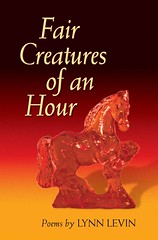
Fair Creatures of an Hour by Lynn Levin

Lynn Levin‘s Fair Creatures of an Hour is a collection of poetry that draws on current events — Smarty Jones in “Little Red Telegram” and skydivers Sara Loshe and Ron Samac in “Freefall” — imagery, and culture to draw in its readers.  Levin intertwines traditional Jewish rituals and stories into her poems, and interjects a fresh perspective.  Readers will intimately understand her and mimic her lines.

“What finer thing is there than to pour out
your thoughts and have someone drink
of your meaning?
It is better than being loved
I sometimes think
for love is not everything.”  (Page 61, “I Wanted to Tell You”)

Levin creates a wistful atmosphere in some of her poems, but easily turns that into something playful.  Even in her most serious poems, Levin cultivates an undercurrent of sarcasm, playfulness, and hope.  From “Peace Is the Blithe Distraction,” Levin repeats the word “peace” and uses each subsequent line to illustrate what peace can mean to even the worst of enemies and how hope plays an integral role.

On the other hand, her humor is ever present as she begins more than one poem with horoscope predictions and planet alignments.  Readers will enjoy the wit shown in these poems and will nod in agreement with many of them.  Levin has an eye for the human condition and the emotions, even those not most desirable. 

The White Puzzle (Page 42)

To love jigsaw puzzles, you have to love trouble —
the mad messing of a picture, the slow steps back to art.
Years ago, my brother and I spent hours
breaking up then piecing back
The Skating Pond by Currier & Ives,
Remington’s The Old Stage-Coach of the Plains
the cardboard pieces colonizing
the game table in the family room.
There was satisfaction in the fitting together
the doing of the definite task
then some days of admiration
of the solved thing before the sundering.
Once someone gave us a white puzzle,
a real head-breaker, the blank pieces
many and small like the counties of a state.
This was fitting for the sake of fitting.
No art in it that we could see, but we stuck to it,
and after a while the pieces began to clump together
like new snow on the lawn.
I remember the way our small talk
scribbled itself over the gathering page:
something about a math bee and Old Man Sprague
who kept sheep in his backyard and had a gun.
We nibbled popcorn, made Montana take shape
with its three sides and human profile,
the pieces knit like bone.
When the white puzzle was complete
we loved the way it lay like moonlight on the floor
then sat before our conquered space,
two Alexanders wanting more.

The poet includes references and explanations in the back of Fair Creatures of an Hour, of which the title is taken from a John Keats poem, “When I Have Fears That I May Cease to Be.”  Levin’s collection is about embracing the moment and being comfortable with oneself before fate steps in.  Well worth reading again and again, Levin’s collection will leave readers wanting more.

Please check out 20th Virtual Poetry Circle for a discussion of Levin’s “Helium.”  Also, for another review, please check out The Pedestal Magazine.  Stay tuned for an interview with Lynn Levin.

I want to thank the poet, Lynn Levin, and Arlene Ang for setting me up with a free copy for review. 

This is my 7th book for the poetry review challenge.
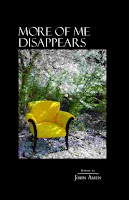
More of Me Disappears by John Amen

John Amen’s More of Me Disappears is broken down into three separate sections and each poem in each section is accessible, vivid, and explosive.  In a number of poems, Amen’s musical and song writing talents permeate the lines.  However, these are more than rhythmic dances, his work gradually moves toward a vanishing point. 

From Verboten (Page 17)

“They are drinking wine and speaking
of French-U.S. relations when the long
sleeve on her arm falls down.  Before
she can clutch it, I see the faded blue
tattoo on her flesh.  “What are those
numbers?” I ask.  A silence explodes
through the room like spores.”

Each poem in this collection tells a story, reflects on a bright memory, and picks these events apart to reveal the truth beneath.  There are times in this volume when the narrator is sure of his path and at other times ideas run contrary to one another.  Some of my favorite lines will leave readers squirming or gritting their teeth.

From Walking Unsure of Myself (Page 65)

“The fortune teller is battling a migraine.
Wind has swallowed my itinerary.

A man in blue goggles is on his knees outside the bank.
The rape victim is scrubbing herself with a steel brush.”

Readers will enjoy the music of these poems and how these poems pop off the pages, with an in your face quality.  Subtlety is not a prevalent style in Amen’s work, but readers will appreciate his frankness.  From poems where the narrator takes an active role to poems to observances from a distance, Amen draws the reader in with immediate and concrete details.  One of the best collections I’ve read in 2009.

New York Memory #3 (Page 36)

“When I get to my dead father’s apartment,
Liz emerges from ruptured planks and exploded plaster.
She is covered with soot, like some pagan baptized
in refuse.  The wrecking crew has come before
we had a chance to vacate the place, stripped the loft
to its skeleton.  My father’s furniture has been destroyed,
a lifetime buried beneath an avalanche of wood and iron.
Beds have been gutted, paintings raped by protruding nails.
A fast-food cup rises from the ruin like a conqueror’s flag.
The apartment is quickly remodeled, rent raised;
the revolving door of humanity spins.  Over the years,
I make a point of knowing who is living there.  I see tenants
come and go.  I accept that we’re not so unlike animals.
I mean, I have this friend who tells me all about bees,
how the queen is revered and protected, ultimately
replaced in a savage deposition, how the mad
hive continues, greater than any one member.
And everything he says sounds familiar, and stings.”

I want to thank John Amen for sending me a free copy of his book More of Me Disappears for review.   For additional examples from this book, visit John Amen’s Web site.

Also, clicking on images and text links to books will bring you to my Amazon Affiliate page.  No purchases are required.

This is my 6th book for the poetry review challenge.

Carta Marina by Ann Fisher-Wirth

Carta Marina was the first largely accurate map of the Northern Countries, completed by the Swedish historian Olaus Magnus in 1539.  Ann Fisher-Wirth has taken her inspiration from this map–complete with its lions, sea monsters, and warriors–for her poem in three parts–Olaus Magnus’ Carta Marina, The Coming of Winter, and Les Tres Riches Neures.

“When I was young, Yeats said, I wanted to take off my clothes,/
now I want to take off my body.” (From April 3. In the Restaurant, Page 61)

Each poem within the overarching three parts of the larger poem, Carta Marina, chart the story of the narrator as she travels through Sweden and the inner heart and soul.  The poems are dated so readers can follow the poet narrator’s progress as they deal with old age, finding a lost love, and incredible loss.

In section one of the poem, readers follow Olaus Magnus on his journey into the north interspersed with email from Paris between lovers.  Fisher-Wirth uses a combination of images and stylistic devices to create her own unique account of a cartographer’s journey, but in some cases, the use of the alphabet was a bit difficult to follow and at times distracting.  Readers may need to sit with these poems, allowing their meaning to simmer to the surface.

“But in the booth facing me the twenty-first child/
chews stolidly, gazing . . ./
lost in whatever dream, as her duckling-colored//

braids bob and her jaws revolve./
Above her pale blue jacket her eyes meet mine;/
I look away, look back, she is watching me./
In this season of coming winter she is my daughter.//”  ( From November 14, Page 33)

The second section of the poem, the narrator is reflecting on her existence and how she relates to those in in her life and life-changing events.  But there is also a reflective self-examination of who she once was and how to reconcile that person who is no longer present with the woman she has become.  From beautiful and mysterious phrases like “icy mercury blackness” to jarring images such as “Three skulls form the base of the table,” readers will transition from thoughtful to alert awe.

In the final third of the book, Fisher-Wirth incorporates some musical rhythm through repetition.  Carta Marina may resemble a cartography of life and aging, but the poem in three parts is a journey, like a journey through the northern lands of Sweden, wrought with harsh weather and rough terrain.  The background story behind the map inspiring these poems is intriguing, but readers could find that they will have to take their time with some of these poems, churning over their images like the Baltic Sea.

December 17, 4 a.m.

I know how to find you.
I go where your sleeping
is filled with the shadows
of leaves, where the leaves have
bled their green,
and all that remain are
their skeletons, nearly
transparent, translucent,
and tissue gone blurred as
the moon among clouds, as
the fur on a moth’s wing,
and tips as if trailing
through water . . .

Such leaves are not common.
In this snowy country
they cherish them, save them,
the white skelettbladen–
like us, they have died, to
become more enduring.

(From Page 47)

I’d like to thank Ann Fisher-Wirth (click her name for my interview) for sending me a free copy of her book, Carta Marina, for review.   Also, clicking on images and text links to books will bring you to my Amazon Affiliate page.  No purchases are required.

This is my 5th book for the poetry review challenge.

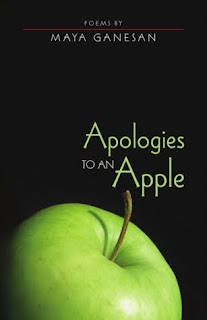
Apologies to an Apple by Maya Ganesan

Apologies to an Apple by Maya Ganesan is a breath of fresh air in contemporary poetry.  At eleven years old, Maya has a crisp style and is very observant and critical.  Her poems do not criticize overtly, like some poets that tend to hammer their messages home.

“They see the horizon, a smoky gold line
over the sea,
and call it names like faraway and
we’ll-never-reach-there.
To them,
horizon is a dream” (From Ash-Colored, pg. 10)

In these simple lines, the narrator observes the horizon in terms of what it means, its location, and how it is perceived by others.  It is an unattainable destination or a dream.

Maya uses short lines to let readers examine the images and statements and discern their own meaning–the greater meaning.  Readers will be reminded of William Carlos Williams‘ short lines, but Ganesan’s work holds a veiled innocence.  For such a young age, Ganesan has an old soul with a great deal of wisdom.  Some of these poems will make readers blush with their self-imposed innuendo.

A Message for You (Page 21)

I have traced your name
with
my finger

on the steamy
glass doors surrounding
the shower.

Readers will find poems to treasure, to savor, and to hold close to their hearts in this slim volume.  As a debut book of poetry, it stands tall among a vast crowd, waiting for readers to hear its whisper.

Yesterday (Page 24)

Yesterday is one book,
today is another.

Different books, telling
different stories.

I like to be part of 
both yesterday and
today, falling out of

one, tipped into
the other.

Her poem, September, was recently showcased in this past weekend’s Virtual Poetry Circle.  Readers enjoyed how the narrator speaks of trees as having souls and feelings.  It is a great commentary on how little we pay attention to the environment and its importance.

Susan at ColorOnline let me borrow her signed copy of Ganesan’s work for this review, though I did first read about this poetry book on 5-Squared.  I’m going to have to get my hands on another copy for myself.

Also Reviewed By:

5-Squared
Book of Kells
ReadWritePoem (also has a list of virtual tour sites for the book)

4th book for the poetry review challenge.


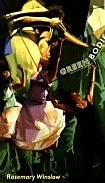
Green Bodies by Rosemary Winslow

Rosemary Winslow’s Green Bodies is divided into three parts, with the first section of poems steeped in deep grief and struggle for understanding following the death of a brother. From “To a Fish” (Page 14-15), “I see a knife/once put to me,/bone opened white to daylight,/red floor on concrete.” Many of these poems have an inner rhythm and musical quality, though the music is dark and somber.

The second section’s narrator begins with poems of cutting oneself off from the outer world and possibly the grief felt in the first section. From “The Gothic Truth” (Page 40), “not making a sound, she watches the grindstone/wobbling hung turning him spitting not stopping/” Throughout the second section, the poems examine the paralysis felt by the narrator by that oppressive grief. From “Carnal” (Page 37), “crumpled and blooded she curled/under a stairwell in hay”

In the final section of this volume, the narrator is rising from the darkness and turmoil of grief to find a way to move on, evolve, and become a stronger self. Readers will enjoy the complexity of these poems, their deep secrets, and highly emotional language.

5 a.m. (Page 54-55)

I rise from a wreckage of sleep
again the long blind scarf of grief

and yesterday and yesterday’s
gunmetal page

the porch lights hiss
at the shroud-hung sky

I go down the stairs to the garden
to be where the roses are leaning

heavy and sweet on the long fence
I lift my face from burial

into burial in the softness of flowers
that is like the skin under the necks of animals

tears shine
in the small white crosses

in their fire centers
the start clematis has made

and entered on
the dead espaliered pear

suddenly I am
jarred

wheep and again
wheep wheep I hear

hidden birds
coming alive

one by one
in the trees

thick pollen of light
undraping the roof lines

composing the sky

This is my 3rd book for the poetry review challenge.
Becoming the Villainess by Jeannine Hall Gailey

Jeannine Hall Gailey‘s Becoming the Villainess is a unique volume of poetry housing poems steeped in Greek mythology, comic book characters, and more.

Gailey’s images are crisp and immediate with recurring uses of pomegranates, wolves, and other items. Alice in Wonderland, Wonder Woman, Persephone, and many more make appearances in Becoming the Villainess, which is separated into five parts. At the end of the book, Gailey includes brief descriptions of the myths inspiring the poems enclosed within its pages.

From “Female Comic Book Superheroes” (Page 5)

Impossible chests burst out of tight leather jackets,
from which they extract the hidden scroll, antidote, or dagger,
tousled hair covering one eye.

They return to their day jobs as forensic pathologists,
wearing their hair up and donning dainty glasses.
Of all the goddesses, these pneumatic heroines most

resemble Artemis, with her miniskirts and crossbow,
or Freya, with her giant gray cats.
Each has seen this apocalypse before.

Each section in Becoming the Villainess examines the evolution of female characters from innocent girls to darker, vengeful women, but these characters are deeper than stereotypical comic book characters, mothers, and goddesses. While some of these poems have a lighter, tongue-in-cheek quality to them, some of them drive home the deep dark horrors found in many legends, myths, and real-life events. One particularly jarring poem in the collection is “Remembering Philomel,” in which a professor is asking for grittier details of the narrator’s sexual assault.

Becoming the Villainess by Jeannine Hall Gailey is a wonderfully insightful collection that looks beneath the surface of myths and sexy comic book characters to find their motivation, their desires, and spunk. If this is your kind of poetry, you should pick it up. I count this among the best of contemporary poetry that I’ve read this year. If you missed my interview with Jeannine Hall Gailey, go check it out.

About the Poet:

Jeannine Hall Gailey was born at Yale New Haven Hospital in Connecticut, and grew up in Knoxville, Tennessee. She has a B.S. in Biology and an M.A. in English from the University of Cincinnati, as well as an M.F.A. in Creative Writing from Pacific University.

Her first book of poetry, Becoming the Villainess, was published by Steel Toe Books in 2006. Poems from the book were featured on NPR’s The Writer’s Almanac and on Verse Daily; two were included in 2007’s The Year’s Best Fantasy and Horror. She recently taught with the Young Artist Project at Centrum. In 2007 she received a Washington State Artist Trust GAP Grant and a Dorothy Sargent Rosenberg Poetry Prize. She volunteers as an editorial consultant for Crab Creek Review, writes book reviews, and teaches at National University’s MFA Program.

Her inspirations often come from mythological sources, such as Ovid’s Metamorphoses or The Tales of Genji, folk and fairy tale collections, and of course, comic books.

This is my second book for the poetry review challenge.

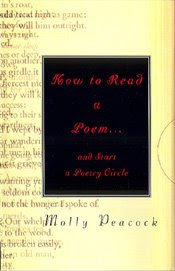
How to Read a Poem. . . and Start a Poetry Circle by Molly Peacock

“I found grown -up poetry to be as spongy as a forest floor–your foot sinks into the pine needles, the air smells mushroomy and dank, and filtered light swirls around you till you’re deep in another state.” (Page 8)

Molly Peacock’s How to Read a Poem . . . and Start a Poetry Circle provides a great deal of information in just 200 pages–from how to interpret poems to how to create a poetry circle and join the ranks of those dipping their feet into the poetic pool.

“Yet as strangely contemporary as this art has become, it involves a timeless childhood pleasure: rereading.” (Page 13)

Peacock clearly knows her stuff from writing verse to examining its structure and images. She postulates that any poem can be examined in three simple steps. Examine the poem line-by-line, which she notes is considered the skeleton of the poem. Examine the sentence, which readers could consider the muscles of the poem. Finally, readers should examine the image or nervous system of the poem. However, Peacock does not suggest that readers pick apart each element of a poem and discuss it ad nauseam.

“This shimmering verge between what is private and what is shared is the basis of a poetry circle. A poetry circle (which is very different from a writing workshop, where people bring in their own poems to be critiqued by one another or by a teacher) occurs when the mutual reading of poetry is at hand. For me, the circle has its beginnings in the side-by-side reading of a poem by two people.” (Page 16)

A number of chapters examine a number of poems, their images, their rhythms, and their internal music. Beyond the application of these techniques on actual poems, Peacock illustrates the beauty of poetry circles, how to start poetry circles, and provides readers with resources to begin their own poetry circles and how to select poetry for discussion in these circles.

“You never know what’s going to catch your finger–or your eye. You needn’t ever be comprehensive about a book of poetry.” (Page 191)

These groups are not like book clubs where copious notes should be taken and entire books should be read. The purpose of a poetry circle is to generate a mutual respect and joy for each line of verse.

After reading this book, I’m going to try an experiment. I want to create a virtual poetry circle. I’ll post a new poem each week for people to read and comment about what they enjoyed about a line, a stanza, or the entire poem. Comments can range from what is good about a poem to what readers don’t like about a poem. Share your thoughts, opinions, and vision of the poet’s work. I’ll probably post these each Friday or Saturday, so keep an eye out.

This is my 1st book for the poetry review challenge.