Quantcast

Midway Meme

Ok, you’re in for a group update.  Here’s the skinny:

Anna from Diary of an Eccentric, after 12 hours, is still reading The Return by Victoria Hislop and she is not halfway through it.  She says, “I’m lazy and don’t want to post.  Please forgive me.”  Anna has yet to finish 1 book yet.  As for interruptions, “We’re reading with a 9-year-old, what do you think?” she says.  LOL  Anna is tired and is looking forward to finishing The Return.  She is slowing down, though, or so she tells me.

The Girl is still reading Bone, but its the second book of Bone she’s read today.  This one is called Bone:  Out From Boneville.  She says, “I’ve been switching between Bone and R.L. Stine.”  She even had the privilege of using her mom’s Book Buddy, and she likes adjusting the ribbons, so much so she was distracted for a bit.  Girl says that there have been interruptions for her too, like movies and playing with the dog.  She is far from tired and very energetic. [It must be the candy.]  She is looking forward to finishing Bone.  Mom says, “For a 9-year-old, she’s doing well.”

As for me, I have three books going right now:  More of Me Disappears by John Amen (poetry), Night of Flames by Douglas Jacobson, and Living Dead in Dallas by Charlaine Harris.  I’m looking forward to having one of these three read in the next hour, which will likely be the poetry book at this point.  Then I will concentrate on the other two.  I’ve only read one book so far, but should have a second book done soon.  There have been interruptions from good movies to The Girl (though not so bad) and time spent cooking to taking the dog out, which were all perfectly fine distractions for me.  I’m not tired yet, and can’t wait to see how long I stay up actually reading, though there is that early yard sale in the morning…

We had some pork loin and corn for dinner and some guac and chips for dessert–not to mention the Halloween candy we’ve been snacking on.
Who Keeps Me Company

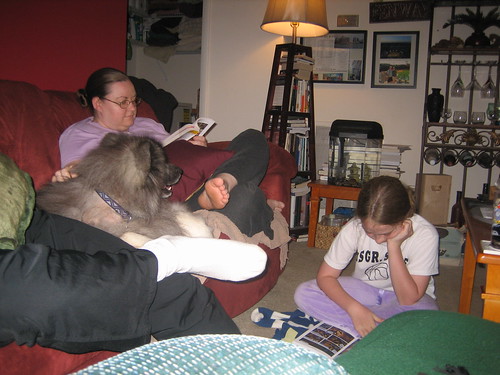
Read-a-thon hour 8:  This mini-challenge is from Under the Boardwalk and asks readers to talk about who or what keeps them company.

Well, here you are.  I have a full house of Anna from Diary of an Eccentric and The Girl.  Her hubby is watching Transformers and my hubby is at work now until 6 p.m.  But you’ll notice I have no company with me on my chair, but my books and my glass of Coke because my dog, Charlee, has abandoned me.

We don’t have any snacks out at the moment since we had a big breakfast and a big lunch.  Dunno what’s on the agenda for dinner, but we’ll think of something.

I’ve read one poetry book, and have been alternating between Sookie Stackhouse #2, Living Dead in Dallas and Night of Flames.

What keeps you company?

7th Hour Entertainment. . .

So, we were in need of a break.  We had some lasagna and garlic bread for lunch, which the men cooked!  I couldn’t believe it.

I’ve finished one book of poetry Carta Marina, and The Girl has finished one book, Bone:  Treasure Hunters.  Anna, well, she’s still plugging away with The Return by Victoria Hislop.

However, we figured we’d take a video of The Girl.  Check it out:

What have you guys been doing to give yourselves a break??

I’ve Been Hijacked. . .

My blog has been hijacked by The Girl who wanted to do a mini-challenge.

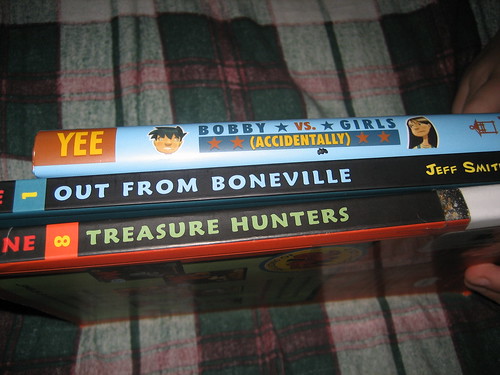
So here’s her sentence from her book titles:


Bobby vs. Girls, the treasure hunters, get kicked out from boneville.

Let’s root for The Girl.

Read-A-Thon Welcome

Good morning.  It’s read-a-thon!  I started exactly at 8AM EST reading, while preparing breakfast.  I started with Carta Marina, a poetry book and got to part two of the three part poem before reading the second book in the Sookie Stackhouse series.

I’m not sure the hubby appreciated me reading poetry out loud to him while we were cooking before Anna and The Girl made it here for read-a-thon.  But I did it anyway.

I don’t know how much I’ll be updating, but I’ll be checking mini-challenges and trying to visit other participants.

We had a big breakfast of scrambled eggs with garlic and oregano, brown sugar sausage, bacon, and pancakes…with coffee naturally, though cocoa for The Girl.

The men are busy playing video game football while we’re reading.  I think they’re in heaven with read-a-thon comes around.

Have a great day and keep reading.

Remember, I’m reading for Poets.org.  If you want the details of my goal, check it out.

18th Virtual Poetry Circle

Don’t forget about the Verse Reviewers link I’m creating here on Savvy Verse & Wit.

Send me an email with your blog information to savvyverseandwit AT gmail DOT com

And now, for the seventeenth edition of the Virtual Poetry Circle:

OK, Here’s a poem up for reactions, interaction, and–dare I say it–analysis:

Remember, this is just for fun and is not meant to be stressful.

Keep in mind what Molly Peacock’s books suggested. Look at a line, a stanza, sentences, and images; describe what you like or don’t like; and offer an opinion. If you missed my review of her book, check it out here.

Today’s poem is a return to contemporary poetry.  In keeping with the Halloween theme, I selected a haiku from Vampire Haiku by Ryan Mecum:

You know that your drink
is down to the last few sips
once the toes curl up.

Haiku has a 5-7-5 count for their respective lines.

Let me know your thoughts, ideas, feelings, impressions. Let’s have a great discussion…pick a line, pick an image, pick a sentence.

I’ve you missed the other Virtual Poetry Circles, check them out here. It’s never too late to join the discussion.

Bump in the Road. . .

Some of you may have expected my review of Night of Flames by Douglas Jacobson for Pump Up Your Book Promotion, but the publisher didn’t get the book to me with enough lead time, so I’ll be posting on Tues. Oct. 27, 2009.

Ok, on to other business. . .

Dewey’s 24-hour Read-a-Thon is this Saturday, Oct. 24, 2009 at 8 AM EST

I’ll be reading again this time around, and although I did post my list already, I wanted to give you an update about some books I added to the pile:

1.  Night of Flames by Douglas Jacobson, which I need to finished.
2.  More of Me Disappears by John Amen (poetry)

3.  At the Threshold of Alchemy by John Amen (poetry)

4.  Fair Creatures of an Hour by Lynn Levin (poetry)

5.  Carta Marina by Ann Fisher-Wirth (poetry)
6.  Vampire Haiku by Ryan Mecum (poetry, naturally)

I thought about my experience last read-a-thon and realized that many of the books I chose to read were large and required quite a lot of concentration.  I decided to add some poetry, which could be read aloud and be more fun–which is good when you need to wake yourself up after reading for long stretches.  This brings my total of books up to 13.  Wish me luck.

If you haven’t joined yet, you should.  Here’s a little incentive.

Additionally, I’ll be reading for one cause. 

Poets.org, which is run by the Academy of American Poets; click here for the donation information.  I’m going to pledge to donate up to $5 per poetry book finished during the read-a-thon.  I hope that you will join me.

The Academy of American Poets does a lot of great things to spread the word about poetry and poets around the nation, sponsoring National Poetry Month events, providing resources for teachers, and offering online access to poetry and poets.   Here are some of the great things you can find on their Web site:  Poem-A-Day, Poem In Your Pocket Day, Free Verse Project, and the Poetry Read-a-Thon.

If anyone would like to join me, I would love to hear about it.  If you are going to read one poetry book during the read-a-thon, I will donate $2 more per book up to $25 to poets.org.

Later today, I’ll be posting the Virtual Poetry Circle post instead of on Saturday like usual.  I hope you’ll find time to participate even if you are preparing for 24-hour read-a-thon.

The Last Dickens by Matthew Pearl

Matthew Pearl‘s The Last Dickens is one of a number of books about Charles Dickens‘ last, albeit unfinished novel, The Mystery of Edwin Drood.  But what sets this novel apart from its compatriots is Pearl’s ability to build suspense and extrapolate from historical events to create a palpable underbelly of the publishing world.  

“A man stretched out on a crusty, ragged couch granted them admission into a corridor, after which they ascended a narrow stairs where every board groaned at their steps; perhaps out of despair, perhaps to warn the inhabitants.”  (Page 199 of hardcover)

Charles Dickens’ final, incomplete novel–he only completed six installments–caused a great deal of controversy as to whether the author indeed had not finished the manuscript, which in those days were released in installments.  Pearl mimics this method by breaking up the narration in separate installments from the Boston publishing house, Dickens’ American tour, Dickens’ son Frank in India at the height of the opium trade, and in England as Dickens’ American publisher Mr. Osgood with his bookkeeper Rebecca Sand search for the lost installments and the true end of Dickens’ final novel.

“At the top of the stick was an exotic and ugly golden idol, the head of a beast, a horn rising from the top, terrible mouth agape, sparks of fire shooting from its outstretched tongue.  It was mesmerizing to behold.  Not just because of its shining ugliness, but also because it was such a contrast to the stranger’s own mouth, mostly hidden under an ear-to-ear mustache.  The man’s lips barely managed to pry open his mouth when he spoke.”  (Page 8 of hardcover)

Pearl includes an examination of the historical accuracies in the novel and which characters were pure fiction or modified historical figures.  One part mystery, one part historical fiction, and one part crime novel, The Last Dickens weaves a complex and detailed story that holds readers rapt attention from beginning to end.

While the chapters involving Frank Dickens’ time in India uncovering an opium trade are not as prominent as some of the other narratives, it is intricately connected to the main story.  However, some readers could find these chapters frustrating because of the gap between those chapters, which could either leave readers frustrated that the tale of Frank Dickens is dropped or anxious for its conclusion.  Most readers are likely to err on the side of anxiety, wanting to know more.

“There are many reasons murder is not always found out, and they are not always for cunning.  The reason might be the fatigue among those who have been deadened on the inside.”  (Page 264 of hardcover)

Osgood is not easily swayed when he is hot on the trail of the missing installments and the end of Dickens’ novel, and as each layer of the mystery is peeled back for the reader, the dark, cutthroat publishing industry is revealed.  Bookaneers are the bottom feeders of the publishing industry, waiting on the docks for the latest installments from the Old World, while publishing giants from New York, like Harper, are eager to acquire these installments by any means necessary and at the expense of their competitors.

The Last Dickens is not just about an unfinished novel or the dark side of publishing.  It also takes a look at human conviction in the face of adversity and how perseverance and a moral compass can yield surprising results.  Pearl is a mystery master, and The Last Dickens will not disappoint its readers.

If you missed Matthew Pearl’s guest post, check it out.  I want to thank Matthew Pearl, Random House and TLC Book Tours for providing me a free copy of The Last Dickens for review.

Click on the title links for my Amazon Affiliate purchasing pages.  

For an additional treat, check out this YouTube video:

For the giveaway for U.S. and Canada residents:  ***Just got word I have 2 copies available***

1.  Leave a comment on this post.
2.  Blog, Tweet, or Spread the Word for an additional entry.
3.  If you follow, get a third entry.

Deadline is Oct. 29, 2009 at 11:59 PM EST

Dewey’s 24-Hour Read-a-Thon

It’s that time again.  Dewey’s 24-Hour Read-a-Thon is this Saturday, Oct. 24, 2009, starting on the East Coast at 8AM.

I’m sure you are wondering what I’ve chosen to read this time around.

Here’s the tentative list:

1.  Living Dead in Dallas by Charlaine Harris
2.  Club Dead by Charlaine Harris
3.  Dead to the World by Charlaine Harris
4.  Bloody Awful by Georgia Evans
5.  Bloody Right by Georgia Evans
6.  Hush, Hush by Becca Fitzpatrick
7.  True Compass by Edward M. Kennedy

What’s on your TBR list?

Matthew Pearl’s Writing Space

With my TLC Book Tour stop for Matthew Pearl‘s The Last Dickens scheduled for Oct. 22, I wanted to provide Matthew with his own guest post date, since he was kind enough to include some photos of his writing space along with the description.

Readers, you are in for a real treat.

This is a timely topic since I’m renovating a house as we speak, so I’ve been forced to think about my writing space from scratch.
We purchased a home built in the 1840s. It needed updating, and for structural reasons we had to do a full gut renovation. On the top floor, away from the (future) hustle and bustle, there were two mirror image rooms, and we knew one would be a guest bedroom and the other my office. My first decision was to choose which I wanted as the office. I actually chose the one facing the street, rather than facing the back of the house. It’s a quiet street and I know if I’m expecting a delivery of some kind I’d be much more productive being able to see it coming rather than constantly getting up to go to the front of the house and check.
 

Sometimes not seeing a distraction coming distracts me.

It’s nice to have some natural light, so we’ve put in a new skylight in my future study. And there’s a nice tree-scape, too, outside the window.

Writing The Last Dickens, I learned about Charles Dickens’s working space. He had two different rooms on his estate that were dedicated offices, and he switched between them seasonally. In one, he wrote the final words on the first half of his final novel, The Mystery of Edwin Drood. A few hours later, he collapsed and never regained consciousness. The circumstances of this gave me my starting point for my novel. Here is one of Dickens’s working spaces from his era (the estate is now a high school):
I confess: I don’t like working at a desk. I work on a couch or, Edith Wharton-like, in bed. I know that’s not good for your sleep (because you then associate bed with work) or probably your carpal tunnels. I’m going to put a small sofa in the office, so I can either nap or work on it. I use the desk more to store and organize papers and folders.
The Last Dickens was written on the top floor we rented in the house below, the upper left window shown here was my office. This house was built in 1871, and my novel took place around 1870. Coincidence, but pretty neat! 
You always have certain knickknacks in your writing space that either inspire or comfort. Wherever my study is, one item always ends up on the wall. There’s a story behind it. When I was writing my first draft of my first novel, The Dante Club, I hadn’t told anyone about the project. Visiting my grandmother in Queens, New York, for lunch, before I left she stopped me. “I was just cleaning out the basement,” she said, “and found this I was going to throw away. It’s a picture of the American presidents. Do you want it?”
Except it wasn’t the American presidents. It was an elongated framed print of “Our American Poets.” With Longfellow, Lowell, Holmes, Emerson. The characters in The Dante Club, which nobody, including my grandmother, knew about! I took that as a sign I was meant to be writing my book. 
That’s always hanging somewhere near my desk. 

Thanks, Matthew, for sharing with us your writing space.  Looks like he has his work cut out for him with that renovation.

The Value of Mess by Laura Brodie

I want to welcome Laura Brodie to the blog.  You’re in for a real treat.  She’s written about her writing space and provided a photographic invitation for all of you.  I want to thank her for taking time out of her busy schedule to provide a guest post.

Without further ado, I’ll turn it over to her post, The Value of Mess.

I wish I could say that my writing space is beautiful—that I have a cozy, book-filled corner, decorated with tasteful artworks, happy family photos, and well-tended plants. In fact, as I write this sentence I am sitting at a dining room table strewn with children’s textbooks, pens and markers, hair bands and sweaters and cough drop wrappers, and piles of papers that need to be recycled.  I haven’t included a photo, because it’s too embarrassing. At my feet lie mangled socks that our puppy likes to gather from my daughters’ bedroom floor. He chews them into shredded clumps, and distributes them around the house.

What inspiration can a writer take from such a messy space, except the most important of all—the motivation to get lost in imagination, far away from the world of laundry and dishes and stacks of college students’ papers.

When I was in college, writing longhand in notebooks, I used to think that I could only be creative in a gorgeous setting. Back then I would sit outside at night on the steps of a church or the banks of a river and write gloomy poetry. I still find that for poetry, elegant journals and long walks provide the best atmospherics. But when it comes to losing myself in the world of a novel or memoir, I’m not so particular. Whether I settle my laptop in the kitchen, dining room or bedroom, the glowing screen draws me in.

My main requirement for writing is not visual, but aural—I need silence. That’s why, when my house is overfull with the sounds of family, I sometimes retreat to my office at Washington and Lee University. There, I have orchids, children’s photos and artwork, and a big sunny window.  But the walls are drab white cinderblocks, shown in this photo taken by a local reporter, who wanted to include author, novel, and website in one picture.

As for that website—it features the chief visual solace in my writing world.  Outside my dining room window I can now see a broad meadow that extends beyond our front yard, divided by a creek that flows toward a barn and trees at the base of the Blue Ridge Mountains. Whenever I need beauty, I can sit on our screened porch, stare at the mountains—now a rusty orange and crimson—and  just breathe. The picture shared here appears on the home page of my website, along with lots of other images from the town and countryside that provide a backdrop for all of my books.

Beauty, however, can be distracting. When writing on my screened porch, I sometimes  spend more time watching the ducks in the creek, or the cows moving over the southern ridge, than concentrating on my words. When that happens, I carry my laptop back inside and settle amid the clutter of my dining room table, where my eyes are only too happy to concentrate on the screen.

And now that my writing for the morning is done, excuse me while I go and clean my house.

Isn’t that just a gorgeous view?  Thanks again to Laura for sharing with us her writing space.  If you missed my review of her debut novel, The Widow’s Season, click on the link and get reading.

Have you seen my interview with Laura Brodie at D.C. Literature Examiner? You should check it out and her Halloween reading selections.

I wish I could have made it to the reading with Laura in Silver Spring, Md., last week (Oct. 15).  If anyone made it to her reading, please leave a comment about how it went.

The Widow’s Season by Laura Brodie

Laura Brodie’s debut novel, The Widow’s Season, is a dirge of grief, wraiths, and resurrection of a professional woman whose been lost in of the song’s cadence for far too long.  Set in Jackson, Va., in a small college town, the season’s change and sweep the protagonist, Sarah McConnell along.

“Sarah McConnell’s husband had been dead three months when she saw him in the grocery store.  He was standing at the end of the seasonal aisle, contemplating a display of plastic pumpkins, when, for one brief moment, he lifted his head and looked into her eyes.”  (First line, Page 3)

Not only does Sarah mourn her husband and the life they had, but she also mourns the life they dreamt about, the life that was snatched from them time and again, and the illusion of their future happiness.  The Widow’s Season is a character driven novel that teeters on the brink of despair as Sarah attempts to navigate her after-life alone.  Nate, her brother-in-law, has lost his mother and his brother in such a short time, and he, like Sarah, does not grieve in an outward display of sobs and outbursts, but turns inward.  Sarah’s friend Margaret anchors her to reality and persuades her to meet for tea every Friday and join her widow’s group once a month.  Unlike, Sarah, Nate’s support system is gone, but he has his investment work to bury himself in.

“An hour later, when she pulled up at the cabin, she had the old sensation of arriving at an empty house.  No lights shone in the windows; the grass was still unmowed.  When she unlocked the door, an immense stillness confronted her.”  (Page 151)

Told in third person, Brodie’s language has a eerie, otherworldly quality that will suck readers easily into an alternate reality.  Grief drips from the pages of Sarah’s life and will consume readers in its wake as she lifts the fog that has surrounded her existence and uncovers her strength, poise, and determination.  Fresh and frank is Brodie’s writing as if she has first hand knowledge of deep desolation and how it can twist reality into alternative that is more palatable.

A great selection for the Fall and Halloween holiday, though it is not a ghost story in a traditional sense, The Widow’s Season is about transformation and living with ones ghosts.

Thanks to Laura Brodie for sending me a free copy of her novel for review.

If you missed my interview with Laura Brodie on D.C. Literature Examiner, you should check it out and find out what she recommends for Halloween reading.  Stay tuned for Laura Brodie’s guest post later today.


Also Reviewed By:

As Usual, I Need More Bookshelves
Missy’s Book Nook