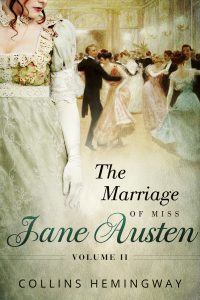
Collins Hemingway has visited us before with Vol. II of The Marriage of Miss Jane Austen. And I’m happy to announce that he’s back with Vol. III, which will be published on Nov. 30.
About the book:
In the moving conclusion to The Marriage of Miss Jane Austen, Jane and her husband struggle with the serious illness of their son, confront a bitter relationship with the aristocratic family who were once their friends, and face the horrific prospect of war when the British Army falters on the continent. The momentous events of the Napoleonic wars and the agonizing trials of their personal lives take Jane and Ashton to a decision that will decide their fate—and her future—once and for all.
Stay tuned for the giveaway details below. Let’s give Collins a warm welcome:
Dubious History of Austen’s Romances Opens Door to Story of Love
Jane Austen’s life is relatively well documented, as a dozen biographies attest. We know she was born and raised at Steventon, Hampshire, moved to Bath (unhappily, it seems) when her father retired in 1801, and moved in 1809 to the now famous cottage in Chawton where she dedicated the rest of her short life to fiction.
But what of the years between her middle twenties until she went to Chawton? Unlike the rest of her life, this seven-year period between 1802 and 1809 goes puzzlingly blank. She remained in Bath until after her father died in 1805 and then, along with her mother, sister Cassandra, and family friend Martha, shuttled around southern England looking for cheap places to live. That effort ended at Chawton when their brother Edward, adopted heir of the Knight family, gave them a permanent home.
Two things are interesting about the seven-year period. First, this spans the years of which her beloved sister Cass destroyed virtually all her correspondence, along with any journals she may have kept. Second, it’s when Jane had one or more serious romantic relationships. One can calculate that there must be a connection.
From the time Jane’s extant letters begin in 1796 until they end with her death in 1817, the surviving correspondence is relatively steady at ten or so letters a year. Yet in her mid-twenties, this dramatically changes.
In this time, we have a three-and- a-half- year gap in Jane’s letters, 1801-1804; a year-long gap, mid-1805 to mid-1806; and a 16-month gap, February 1807-June 1808. We have only 13 letters—not quite 2 a year—from 1801 to late 1808, when they begin again with some regularity. Besides the occasional passing reference to her in other people’s letters and diaries, we know nothing of Jane’s whereabouts or doings for this time.
The romances are of this time, too. According to the family, in 1828 Cassandra saw a man who reminded her of a one-time suitor of Jane, and she told her nieces Caroline and Louisa that they had met the beau on the Devonshire coast in 1801, he and Jane had fallen in love, and they were to meet again, when a proposal was expected. Instead Jane learned that he had died. Cass says he was “pleasing and very good looking,” but never provides the man’s name.
Manydown Park, where Jane Austen attended many balls and, according to one niece, accepted and rejected a marriage proposal.
What’s odd is that Cass does not mention this story until 1828— more than a quarter-century after it is supposed to have happened! The nieces cannot even agree about where on the Devonshire coast this romance occurs. Cassandra spreads more confusion than information about that circumstance.
Even speaking about this expected proposal, she apparently fails to mention to her nieces a proposal that Jane supposedly did receive in December 1802. Biographers dutifully recount the engagement to Harris Bigg-Wither, when (the story is) she accepted a proposal from the wealthy but boorish young man, recanted it overnight, and, humiliated, fled back to her parents in Bath.
Harris Bigg-Wither was supposed to have proposed to Jane Austen, but the provenance of the story is confusingly suspicious.
What is strange, however, is that this purported engagement and refusal, which would have created a scandal, does not appear to show up in any surviving contemporaneous letters or journals by anyone who knew Jane. The event is not recorded until nearly 70 years later by one of same nieces, Caroline, who was not even alive when it supposedly occurred in 1802!
Caroline sourced the story to her mother, Mary, who died in 1843—26 years after Jane died, 41 years after the event, and 27 years before Caroline’s telling. How would Mary have recalled the exact dates, December 2-3, 1802, of a proposal involving a sister-in- law she was not close to?
The proposal is recounted in the first memoir of Jane, put together by James Edward, Caroline’s older brother, with Caroline’s help. James Edward was 19 when Jane died—he attended her funeral on behalf of his father—yet he sources his younger sister for the tale of the botched proposal. Wouldn’t he have heard the story around the dining room table from his parents himself?
How is it this story is handed down by a niece too young to have known about it directly but not by the many other nieces and nephews who were alive?
Both of these “romances” come across as a bit unreal. There are too many specifics in one major encounter (Bigg-Wither) and far too few in another (the mysterious suitor on the beach). Were there separate romantic encounters, each one ending disastrously, or perhaps one relationship that these inconsistent stories point to—or are designed to point away from?
When Austen began to be famous and her family took notice, society was now in the middle of the repressed Victorian era. As the memoir makes clear, her nieces and nephews were happy to bury any suggestion that Austen would have ever done anything untoward such as write to make
a living or—fall in love. (The author Virginia Woolf, in contrast, says that “Persuasion” proves that Austen had loved intensely and by 1817 no longer cared who knew.)One does not have to be a conspiracy theorist to envision the possibility that there may have been a very serious relationship overlooked or even hidden by her prim and proper descendants. What if Jane Austen had married? What if she had met someone very much her equal but also the sort of man a Victorian might want to lose in the mists of time?
What kind of man might that be? How would their relationship have begun? (Might bits and pieces of the history be true?) How would it have developed? How would it have ended? This possibility led me on a lengthy research and writing project culminating in the release this week
of the third and last volume of “The Marriage of Miss Jane Austen.”The trilogy spans these seven years of 1802-1809: Volume I, a love story; Volume II, a deep psychological portrait of a woman’s first year of marriage; Volume III, which tests Austen’s courage and moral convictions as she must face the most difficult choices of life.
My goal was to tell a tale of a meaningful relationship built upon the “understanding” Austen often writes about. I wanted to see how, as a married woman, she might have fit into the large and turbulent world of the Regency. Perhaps most important, I wanted to see how the archetypal
woman of the period would have handled all that marriage meant for a woman of that day.


Giveaway Info: (open internationally)
Enter by Dec. 5, 2017, to win one e-book volume of your choice from Collins Hemingway or a print copy if you live within the United States.