Quantcast

Guest Review: Songs In Ordinary Time by Mary McGarry Morris

Review by H. C. Newton at The Irresponsible Reader

Rating:

songsinordinarytimeThere’s a stereotype about Oscar-bait movies the come out late in the year, super-serious movies with super-serious actors about families in crisis, social unrest, a woman standing on her own, and so on. Nothing anyone really wants to see, but we all take it seriously. Yes, that’s a stereotype, an over-generalization, blah blah blah — but we all know that kind of movie. This book is like that — deadly serious, grim, full of people with no capacity for joy or to make a wise decision — or any action that involves a lack of melodrama.

I just couldn’t force myself to care about this one — not one bit.

The book centers on a divorced mother of three, Marie Fermoyle, and her children: Alice, Norm and Benjy. Marie’s barely scraping by, teeters between despondency and angry outbursts. Until Omar Duvall comes to town. The best thing that could possibly be said about Omar is that he’s a two-bit hustler and womanizer. Much worse could be said about him. Marie is so desperate for a way out of her life, that she falls for his flummery. Sam, Marie’s ex, is the town drunkard — an hopeless alcoholic, surviving on crumbs his sister gives him to get by, the children go out of their way to avoid him — as does pretty much everyone. The new priest in town, and Sam’s brother-in-law are pretty much the only exceptions to that. The priest is, well — he has problems, and the brother-in-law is henpecked and an obscene phone-caller. There are other characters — several, in fact — but let’s limit this to these characters. I could go on and on. Not unlike Morris.

This collection of characters are the greatest conglomeration of self-centered, self-pitying, self-deceived (often), self-justifying, and miserable people I can imagine. And everything they do (well, 99% of the things they do, anyway) make their lives worse (and half of that other 1% is ruined almost immediately). On page 508, I jotted down in my notes, “Please, someone, stop this book — just put these people out of their misery! Mine, too!”

These people are so miserable, so self-pitying that I laughed out loud when I read Marie thinking, “Hope . . . there was more of that in her veins than blood.” Really? I couldn’t believe that for a second. About 200 pages later, we read, “She was so very, very tired. All this, she thought, biting her lip, all this because once, a long time ago, she had made a fatal mistake. She had fallen in love too young with the wrong man. Imagine, it was as simple as that and now she would never catch up. She would never be happy.” That I could believe. That’s one of the most honest sentences in the book.

Each male character (I think without exception — two children, are probably exempt) is able to talk a good game, able to spin a tale about something to make the people around him believe in him — and typically even fools himself. It happens at least once for every character — each time I disliked them more and more for it.

The main plot centers around Marie falling for Omar’s line and risking everything while underwriting a pyramid scheme that he’s peddling (as does a whole lot of the town), while alienating her two older children along the way. Her youngest knows better than the others suspect how terrible Omar is, but he suppresses that information and knowledge so his mother can hopefully be happy. There are crimes not associated with Omar, people dying, people suffering, people trying (and generally failing) to escape their pasts and improve their life. There are two characters out of this that might succeed in improving their lot in life, but we’re not given enough information to know for sure — a couple of others that seem to have turned a corner, but if the 700 previous pages are any indication these latter characters are 5 pages away from running back around that corner the other way.

So why did Entertainment Weekly put this one on their list for Vermont? I’m only guessing here — there aren’t that many novels set in the Green Mountain State. There was nothing distinctly Vermont about this book, as far as I could tell. It was Anytown, USA — there was a lake nearby, a university not too far away (but far enough), a Roman Catholic Church in town (maybe a Protestant one, too — but I’m not sure), one drive in, and a few small towns within an hour or two by car. That’s really all we learn about the geography. The state name is invoked a few times, but otherwise, it could literally be anywhere — like The Simpsons‘ Springfield. I learned nothing about that state, its people, or anything beyond another lesson in endurance in the face of overwhelming tedium.

Plot(s), character, setting — this book failed on all three. It was well-written, I guess, but there was nothing special about even that. I really have nothing positive to say about this one, if you haven’t noticed.

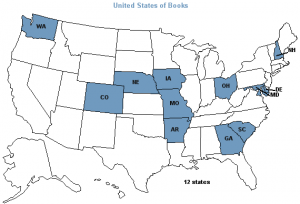
VT Map US of Books

Guest Review: Fear and Loathing in Las Vegas: A Savage Journey to the Heart of the American Dream by Hunter S. Thompson, Narrated by Ron McLarty

Review by Wattle @ Whimsical Nature

fearandloathinginlasvegasFear and Loathing in Las Vegas by Hunter S. Thompson, Narrated by Ron McLarty

Rating: 2/5

Synopsis: In Las Vegas to cover a motorcycle race, Raoul Duke (Thompson) and his attorney Dr. Gonzo (inspired by a friend of Thompson) are quickly diverted to search for the American dream. Their quest is fueled by nearly every drug imaginable and quickly becomes a surreal experience that blurs the line between reality and fantasy. But there is more to this hilarious tale than reckless behavior, for underneath the hallucinogenic facade is a stinging criticism of American greed and consumerism.

Review: I’ve been to Las Vegas exactly once, I thought it was a bit odd, a bit dirty and not a place I would like to spend any considerable amount of time in. I felt similar things toward this book. I’ve tried to read it before in paperback, and I put it down after five pages or so. I have seen the film and hated it; so when I saw this on my list for review I was a little worried.

Rightly so, it turns out.

I opted to listen to the audiobook in the hope that I would find it more engaging than if it were text. Ron McLarty did a wonderful job with the narration, I really liked listening to him, but Fear and Loathing in Las Vegas was such a tedious story. The 6 hours I spent listening to it felt like 6 years.

This story is meant to be hilarious and surreal. I think I laughed once, and it was more of a derisive snort than actual laughter. I’m still not entirely sure what the point of the book was, there was such excess and stupidity and vastly irresponsible behavior.

If it was trying to teach me a lesson, I failed to see it (unless that lesson was – don’t do drugs). The characters were all unlikeable; the story felt like it was just a rambling bunch of sentences thrown together with little direction. The content was definitely not for me (I don’t even drink, so the characters desire to be constantly wasted was beyond me), I felt the casualness of their drug taking and ridiculous behavior in general was more worrying than amusing.

I gave it two stars, 1.5 for the narration (which was really very good) and 0.5 for the work itself – it was much too far out of my comfort zone and just a bit too strange for me to get into. A pity, because I think if it had been different way, it would have been a much more engaging work.

USofBooksNevada4.25.16

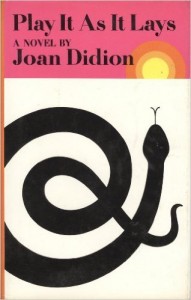
Guest Review: Play It As It Lays by Joan Didion

Welcome to another installment of the United States of Books! See full details here. Today we will visit California with Play It as It Lays by Joan Didion. Entertainment Weekly say’s “Didion’s 1970 classic, about a woman and a marriage breaking down, is both an ode to the freedom of the freeways and a eulogy for dreams shriveled by the sun.”

playitasitlaysSYNOPSIS (From Goodreads.com)

A ruthless dissection of American life in the late 1960s, Play It as It Lays captures the mood of an entire generation, the ennui of contemporary society reflected in spare prose that blisters and haunts the reader. Set in a place beyond good and evil – literally in Hollywood, Las Vegas, and the barren wastes of the Mojave Desert, but figuratively in the landscape of an arid soul – it remains more than three decades after its original publication a profoundly disturbing novel, riveting in its exploration of a woman and a society in crisis and stunning in the still-startling intensity of its prose.

REVIEW by By Elisha at Rainy Day Reviews

I don’t think this book is your typical read, like a James Patterson or Jodi Picoult … not saying they are typical because they are amazing and talented authors. But Joan Didion is not a Jodi Picoult type author. Joan grabs you with this story from the very beginning, waiting for the other shoe to drop. With school, my child, and life in general, it took me a couple weeks to read this “can’t put this book down” book because I wanted to see if this ‘sad female with nothing but time and money’ would do something with herself and stop feeling sorry for herself. I did have empathy for her as the story continued because as the reader can tell she is truly sad and can’t pull herself out of it.

You want to go into the book and shake her but hug her at the same time. There was twists and turns in this story I was not expecting but was pleasantly surprised by. I tend to be a cynical person (in the Miranda from Sex in the City kind of way) so when I started reading Maria’s character, I thought oh good Lord…but then, something happens (no spoilers!) This was a memorable read, for sure. It is also one that I would recommend to others.

USofBooksCali4.18.16

Guest Review: The Yearling by Marjorie Kinnan Rawlings

Today’s guest review is from Laura at 125Pages.com

Rating: 3 Stars

Welcome to another installment of the United States of Books! See full details here. Today we will visit Florida with The Yearling by Marjorie Kinnan Rawlings. Entertainment Weekly say’s “Working with Hemingway and F. Scott Fitzgerald’s editor, Rawlings was pushed to look into her own history for literary fodder, which led to her 1938 Pulitzer winner about a Florida boy and his pet deer.”

bambigif

The Yearling is a book I have heard about over the years, but was never super interested in reading. I could guess the outcome of a book centered around a young boy and his pet deer living on a hardscrabble farm in the 1870’s. I had read Old Yeller and seen Bambi, I knew what was coming. So I wasn’t thrilled when the random picking for the United States of Books challenge offered me up The Yearling. I don’t think I can really spoil a book that is over 75 years old, but just in case, I will only say I was right about the ending. However, I was mistaken about how I would feel about the book as a whole.

The tale of the Jody, Ora and Ezra “Penny” Baxter is not one of an easy life.  Farming a small plot of land in central Florida, they hunt and trade for what they need. Jody is the only child of seven born, who lived past the age of three. Trailing his pa and learning to do what is necessary to survive, Jody wants nothing more than a pet to call his own. Then on a hunt, he finds a small deer and is determined to make it his own. Flag soon becomes part of the family and even goes on hunts with Jody and his father. Weaving around the story of the fawn and his boy was the epic hunt of a troublesome bear, a snakebite, and a very unique cast of characters.

Now that I have read it, I am glad I had the chance to, as some of the writing was just lyrical.  Especially the parts describing the land surrounding the farm.

Around a bend in the road, the dry growth of pines and scrub oak disappeared. There was a new lushness. Sweet gums and bay were here, and, like sign-posts indicating the river, cypress. Wild azaleas were blooming late in the low places, and the passion flower opened its lavender corollas along the road.

I could see why this was EW’s Florida pick as the location was almost a secondary character in the story. The wildlife and flora inhabited every scene.

The fall fruits were not yet ripe, papaw and gallberry and persimmon. The mast of the pines, the acorns of the oaks, the berries of the palmetto, would not be ready until the first frost. The deer were feeding on the tender growth, bud of sweet bay and of myrtle, sprigs of wire-grass, tips of arrowroot in the ponds and prairies, and succulent lily stems and pads. The type of food kept them in the low, wet places, the swamps, the prairies and the bay-heads.

Unfortunately, the jarring difference between the lyrical descriptions and the regional dialect of the characters when they spoke, made this a difficult read for me. The way they thought in their heads did not match the words they said and this made the transitions very hard. I would almost prefer a read like The Adventures of Huckleberry Finn where, while there were numerous regional dialects, all the characters thought and spoke in them. When you read a description as beautiful as the one above then the very next life is something along the lines of “Don’t go gittin faintified on me.”, it pulls you out to the story and throws a wrench in your pacing.

Cover_of_The_Yearling_1938The Yearling had some amazing moments with the descriptions by Marjorie Kinnan Rawlings. It is not a book that I would personally read again as the storyline is not what I enjoy and the transitions between characters thinking and speaking was too harsh. For the time it was written though, I can see why it received such high praise. It contained heartbreak, action and basic human survival tempered by a strong family bond.

Favorite lines – “A mark was on him from the day’s delight, so that all his life, when April was a thin green and the flavor of rain was on his tongue, an old wound would throb and a nostalgia would fill him for something he could not quite remember.”

Have you read The Yearling, or added it to your TBR?

Guest Review: The Grapes of Wrath by John Steinbeck

Guest Review by C.H. Armstrong Books & Blog

SYNOPSIS (From Goodreads.com):

First published in 1939, Steinbeck’s Pulitzer Prize winning epic of the Great Depression chronicles the Dust Bowl migration of the 1930s and tells the story of one Oklahoma farm family, the Joads, driven from their homestead and forced to travel west to the promised land of California. Out of their trials and their repeated collisions against the hard realities of an America divided into haves and have-nots evolves a drama that is intensely human yet majestic in its scale and moral vision, elemental yet plainspoken, tragic but ultimately stirring in its human dignity.

A portrait of the conflict between the powerful and the powerless, of one man’s fierce reaction to injustice, and of one woman’s stoical strength, the novel captures the horrors of the Great Depression and probes the very nature of equality and justice in America.

Sensitive to fascist and communist criticism, Steinbeck insisted that “The Battle Hymn of the Republic” be printed in its entirety in the first edition of the book—which takes its title from the first verse: He is trampling out the vintage where the grapes of wrath are stored.” As Don DeLillo has claimed, Steinbeck shaped a geography of conscience” with this novel where there is something at stake in every sentence.” Beyond that—for emotional urgency, evocative power, sustained impact, prophetic reach, and continued controversy

—The Grapes of Wrath is perhaps the most American of American classics.

grapesofwrathREVIEW – 5 Stars

When The Grapes of Wrath was released in 1939, it was not only an instant bestseller, but it was met with no small amount of criticism and anger. Steinbeck brought to the world the devastation of the Dust Bowl but, more importantly, the horrors and blatant racism that greeted migrant workers searching for better lives.  For as many who read Steinbeck’s epic novel and heralded it as the true “Great American Novel,” an equal number were aghast at the raw truths he portrayed and sought to have it banned or even burned. Nearly seventy years later, it’s still at the center of much controversy and is listed as Number Two among the Top 10 Most Banned Books (Shortlist.com).

The Grapes of Wrath is an epic novel depicting the mass westward migration of Oklahomans (and neighboring states) during The Great Depression of the 1930s and the simultaneous Dust Bowl.  It was a time when the overuse of the land had turned the once fertile farming soil into dust, making it unfit for the growing of crops.  With no money coming in from the crops, banks swooped in and called in loans on the land, and forced tenant farmers and their families out of the homes they’d known for generations.  The result was mass homelessness that led to a great migration to California and nearby states in search of jobs.

At the center of Steinbeck’s novel is the Joad family. Their eldest son has just been released from prison and returns home to find his family packing up their meager belongings, ready to depart for California and hopes for a better life. So begins the story of the Joad family and their journey west. But they soon realize that their travels will neither be easy, nor as idyllic as they had imagined. Instead of green fields of orange trees ripe with fruit just for the picking, they’re met with numerous hardships and discrimination. California – the land of plenty and the focus of their dreams – doesn’t want them. They’re not only barred from entrance but, once gaining access, are met with conditions more deplorable than those they’ve left behind.

When The Grapes of Wrath was first released, it was met with criticism from groups crying foul at Steinbeck’s depictions for how migrant workers were treated. In truth, Steinbeck revealed that his novel was a watered-down version of the true horrors of the workers – the truth was worse than the fiction of his novel.

As a native Oklahoman and one who finds pride in the name “Okie,” I can only tell you that I truly loved this novel. I loved Steinbeck’s descriptive prose; but more than that, I loved the truth behind his words, which echoed through my mind long after I turned the last page.

Many will say that The Grapes of Wrath is a depressing novel. On the contrary, I found it to be a book of hope and a testament to the strength of the human spirit.  Yes, it was difficult to read about the hundreds of thousands of starving migrant people; and it was even more difficult to come to terms with the fact that “this really happened!”  But what I really got from the story was a lesson in discrimination and racism, and hope for the future of mankind.  You see, even when all had been taken from them and there seemed to be no real hope in the foreseeable future, the Okies refused to just lay down and die.  They refused to let the “big guy” get the best of them.  They trudged on through death, hopelessness, starvation and despair.  They did their best to keep their families together, and they never failed to lend a helping hand to one whose need was even greater than their own.  Nearly 100 years later, the majority of Oklahomans still possess those admirable qualities.

Oklahoma

Guest Review: The Descendants by Kaui Hart Hemmings

The United States of Books: the State of Hawaii
Guest Reviewer ~ Teri at Sportochick’s

DescendantsThe Descendants by Kaui Hart Hemmings
-Reviewed using Audible and eBook

~ SYNOPSIS ~

Narrated in a bold, fearless, unforgettable voice and set against the lush, panoramic backdrop of Hawaii, The Descendants is a stunning debut novel about an unconventional family forced to come together and re-create its own legacy.

Matthew King was once considered one of the most fortunate men in Hawaii. His missionary ancestors were financially and culturally progressive–one even married a Hawaiian princess, making Matt a royal descendant and one of the state’s largest landowners.

Now his luck has changed. His two daughters are out of control: Ten-year-old Scottie is a smart-ass with a desperate need for attention, and seventeen-year-old Alex, a former model, is a recovering drug addict. Matt’s charismatic, thrill-seeking, high-maintenance wife, Joanie, lies in a coma after a boat-racing accident and will soon be taken off life support. The Kings can hardly picture life without her, but as they come to terms with this tragedy, their sadness is mixed with a sense of freedom that shames them–and spurs them into surprising actions.

Before honoring Joanie’s living will, Matt must gather her friends and family to say their final goodbyes, a difficult situation made worse by the sudden discovery that there is one person who hasn’t been told: the man with whom Joanie had been having an affair, quite possibly the one man she ever truly loved. Forced to examine what he owes not only to the living but to the dead, Matt takes to the road with his daughters to find his wife’s lover, a memorable journey that leads to both painful revelations and unforeseen humor and growth.

~ REVIEW ~

★ ★ ★ 1/2

Though traditionally this book would not of caught my eye I was interested in reading it because of my love for Hawaii. From the start the author did an admirable job of creating irritating spoiled children in the characters of Scottie and Alex. The addition of Alex’s friend, Sid who has his own set of problems and annoyingness rounded off for me a difficult read. It is not that the book isn’t well written but I wanted to take all of them over my knee and spank them or hug them to death.

As a mother I was stressed during this whole book and angry with Matt that he had not been more present in his daughter’s upbringing and he allowed his wife free rein without question. As the story went on though he started to show superb judgement in how he handled so many of the new situations that showed up. The author did a fine job in the steadiness of Matt still making mistakes and where his aha moments happened, causing a change in his thoughts and actions.

Joanie is written in a very believable manner and one wonders if she ever thought of the damage she was doing to her children or if she was that clueless that she thought she was helping them. Her character is not likable for all the thoughtless damage she did to everyone around.

For me the interaction between Matt and Sid was the most impactful part of the story.  Both of these two saved each other is ways that only they understood. What these two did for each other was amazing and heartfelt making me cry.

For this review I listened to it via audible and referenced the ebook version as well. I wonder if I had only read the book if I would have had a different outcome in my review. Though I haven’t seen the movie I wonder how this book would come across on the screen so out of curiosity I will see it though.

I give this 3-1/2 STARS.

Hawaii

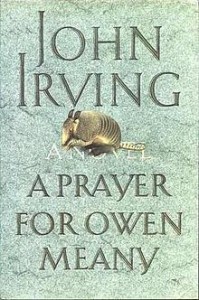
Guest Review: A Prayer for Owen Meany by John Irving

Today’s guest review as part of the United States of Books is from H. C. Newton at The Irresponsible Reader

PrayerForOwenMeany★ ★ ★ ★

[Marilyn Monroe] was just like our whole country — not quite young anymore, but not old either; a little breathless, very beautiful, maybe a little stupid, maybe a lot smarter than she seemed, and she was looking for something . . . She was never quite happy, she was always a little overweight. She was just like our whole country.

I’m not sure why I picked that quotation from this book, but there’s something that appealed to me about it (even if I don’t necessarily agree). You’ll note that there are both upper and lower case letters there — Owen Meany’s dialogue is always given to us in all caps. Which is annoying (it’s supposed to be), and difficult to read in extended speeches (Owen’s voice is hard to listen to), and makes you wish he’d shut up (duplicating the experience of most people who heard him).

A medical explanation for this is given, eventually. But the only explanation that Owen needs is that God gave him his voice. The same for his diminutive stature (about 5′ 0″ as an adult)
— God made him that way, for His own reason.

But I’m getting ahead of myself — John Irving’s probably best known for The World According to Garp, which was one of the bigger disappointments of my college reading, so I wasn’t really looking forward to spending more time with him. You add in the fact that this is a 500+ page book with only nine chapters, and it’s downright intimidating. I’m not going to say that you shouldn’t be intimidated and that it’s a pretty easy read — it’s a challenge, it’s frequently a slog — but in the end, it’s rewarding.

When the book starts, Johnny Wheelwright (the narrator) doesn’t seem particularly fond of Owen Meany — in fact, you get the impression that he’s just one of those kids he happens to know, and he’s not that happy about it. But before long, it’s clear that he and Owen are really close — even though (because?) Owen’s responsible for the greatest tragedy of Johnny’s childhood.

John finds himself as an observer to Owen’s life, as his defender, his advocate, his way to the greater world. While Owen is constantly trying to help his friend — help him to achieve, help him to think, help him to believe. It’s a great friendship — and without the other, each was diminished. Owen less so, but in important ways.

The narrative is rambling — John starts to tell us about something, the plot moves forward a bit, but then he goes back in history to give context. Sometimes weeks, sometimes years and far more detail than you think is necessary. Eventually, you see that this is sort of the approach that the overall narrative is taking — John has something he needs to tell the reader, but he doesn’t want to. So he tells you many other things, anecdotes, vignettes, details you don’t need — anything to delay what he wants to say. He does get to it. And by that time, you’re not sure you want him to.

The story is told from the perspective of forty-something John, now a teacher at a Private School in Toronto — he spends his days reading the news about the United States, and ranting (or trying not to) to anyone near him about what President Reagan is doing. I’m not sure why we spend so much time dwelling on him in the present, we don’t need it — it adds almost nothing to the narrative. If anything, I think it might lessen the impact of the rest. The adult John telling the story about his childhood, about Owen, about their growing up together, and so on is essential — we need his perspective, his distance. What we don’t need is to hear John’s rants about Reagan, the poor reading/study habits of teenage girls.

I’m not sure that I get a whole lot of understanding of New Hampshire from this book — Owen’s family working in the granite industry doesn’t tell us much, New Hampshire is The Granite State — everyone who survived 4th grade knows that. If anything, Irving was wanting to talk about America — as an ideal, and as something that falls short of that ideal. Monroe was one example, John Kennedy’s moral failings another, Vietnam a recurring theme, and, of course, the Iran-Contra Scandal. Each of these, as either a representative individual, or representative act, demonstrates how far (in John’s/Owen’s view, at least) the United States has fallen short of the ideals it should strive for — if not achieve.

Ultimately, when I enjoyed this book, it felt like it was in spite of what I was reading. But I laughed, I cared, I kept reading — and then when I was finished, I appreciated the work as a whole, and felt a lot more affection for it than I expected. It’s hard to explain, but I liked this one and heartily recommend it.

New Hampshire

Guest Review: True Grit by Charles Portis

Today’s review is from Wattle at Whimsical Nature.

truegritTrue Grit by Charles Portis
Rating: 3/5

Synopsis:

There is no knowing what lies in a man’s heart.  On a trip to buy ponies, Frank Ross is killed by one of his own workers. Tom Chaney shoots him down in the street for a horse, $150 cash, and two Californian gold pieces. Ross’s unusually mature and single-minded fourteen-year-old daughter Mattie travels to claim his body, and finds that the authorities are doing nothing to find Chaney.  Then she hears of Rooster – a man, she’s told, who has grit – and convinces him to join her in a quest into dark, dangerous Indian territory to hunt Chaney down and avenge her father’s murder.

Review:

I must admit, I saw this on my list of books to read and sighed. I hate westerns, and had the misfortune (in my opinion) of seeing half of the most recent movie based on True Grit. So it was with dread that I opted to read it first, deciding to read in order of least want to read to most interesting.

How wrong was I?! The writing sucked me in from the start, it wasn’t stuffy and formal as I assumed it would be. However, at times the dialogue felt a bit stilted; and the deeper into the story I got, the more I realised that it had no real complexity. It is simply about wanting revenge to (in Mattie’s eyes) right a wrong.

Mattie is feisty and strong willed. She felt older than her 14 years, no doubt because of the setting she was in; the late 1800s, her father has been killed and she’s the oldest child, so needs to take care of his affairs. Which in her mind, means finding her father’s killer and watching him die. To do this she needs help, and sets out to recruit the best and worst Marshal she can find – which leads her to the drunken and often too quick to shoot Rooster Cogburn.

I liked Rooster (what you see is what you get, and he’s a bit of a brute – though showed great patience with Mattie) and did not like LaBoeuf (an arrogant Texas Ranger who happens to be after the same man).

It was a fine story, but the ending to their adventure felt contrived – and I can’t say I was a fan of the ending proper either. I felt a little cheated that all we really got of Mattie was her experience as a 14 year old, and then many years in the future, and nothing in between. I suppose there was some character growth for her throughout the story, given she had just lost her father and wanted justice; but it was somewhat lost in the details of the story.

Not being from Arkansas (or even America) I have absolutely no idea what the place is like, but I got the feeling that back in the 1800s it was a bit dusty and a bit rundown, with lands that criminals could easily disappear into? There was apparently quite a few of them in the same place (which I suppose is fortunate for the Marshals tracking people).

All in all, this was a quick and easy read but didn’t have the complexity I was expecting and fell a little short for me, but it was still a good read and got me out of my comfort zone!

USbooksArkansas

Guest Review: The Absolutely True Diary of a Part-Time Indian by Sherman Alexie, illustrated by Ellen Forney

Today’s review for the United States of Books is from Elisha at Rainy Day Reviews

Entertainment Weekly says about their Washington state pick– “Alexie grapples with serious issues through the not-always-serious voice of a 14-year-old caught between his life on the reservation and his entry into an all-white high school.”

The_Absolutely_True_Diary_of_a_Part-Time_Indian_coverSynopsis:

Bestselling author Sherman Alexie tells the story of Junior, a budding cartoonist growing up on the Spokane Indian Reservation. Determined to take his future into his own hands, Junior leaves his troubled school on the rez to attend an all-white farm town high school where the only other Indian is the school mascot.

Heartbreaking, funny, and beautifully written, The Absolutely True Diary of a Part-Time Indian, which is based on the author’s own experiences, coupled with poignant drawings by Ellen Forney that reflect the character’s art, chronicles the contemporary adolescence of one Native American boy as he attempts to break away from the life he was destined to live.

Review:

I was intrigued with this book once I learned that this story was based on the author’s own experience. I was not aware of the coarse language in the book until I began reading it; which in my opinion makes this read inappropriate for younger readers. However, that said, I did appreciate that even though this teenager saw a lot of heartache and injustice, including racism and death, there is a lot of laughs throughout the story.

I like the narration of the book, hence the title. That was different than the typical read. Gave it a different feel from a story being told. Even with the racial divide in the story that the boy dealt with, I think this story is very relatable to other young adults out there (tragedy in life, being bullied, and the instability that life can bring with its ever-changing twists that life tends to do to all of us. All in all, a good book and a quick read that I would definitely recommend to everyone to read.

* Disclaimer: language may be coarse for some readers*

USbooksWashington

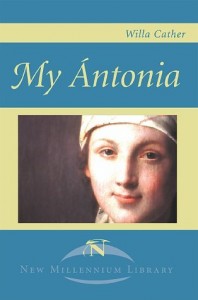
Guest Review: My Ántonia by Willa Cather

USbooksNebraskaFebruary is the second month of the United States of Books (click here for further details).

The United States of Books: the State of Nebraska

Today’s review is from Teri at Sportochick’s Musings.

My Ántonia (Great Plains Trilogy #3) by Willa Cather

MyAntoniaBlurb ~ 

Through Jim Burden’s endearing, smitten voice, we revisit the remarkable vicissitudes of immigrant life in the Nebraska heartland, with all its insistent bonds. Guiding the way are some of literature’s most beguiling characters: the Russian brothers plagued by memories of a fateful sleigh ride, Antonia’s desperately homesick father and self-indulgent mother, and the coy Lena Lingard. Holding the pastoral society’s heart, of course, is the bewitching, free-spirited Antonia.


Review ~ ★ ★ 1/2

This story is narrated in first person by Jim Burden in what I think is a very plain unemotional manner. I honestly had a hard time reading this book and at points kept putting it down. It was puzzling to me that for all of the unusual dramatic events in this book it was for me unemotional. I am not sure if listening to it on Audible and switching off and on with the book impacted my feelings. Though these dramatic events in the book were described in fine detail my mind felt a distance from the writing.

Two characters did stand out. Antonia who was very expressive and Jim’s grandfather for the ways that he dealt with crisis’s, personality issues and his deep integrity. Antonia throughout the book was very emotional and it was obvious to see why quiet Jim liked to be around her and had grown to love her.

I finally connected with the book in the last chapter and a half where it became to me a book worth reading. This part of the book make me feel great sadness for Jim and Antonia and where they were 20 years later. The ending was poignant and still brings tears to my eyes.

This book leaves the readers pondering the what if. What if Jim didn’t go away to college? What if Antonia made a different decision when her first love deceived her? What if Jim had told her he loved her? But the largest question that I had was how did Jim love Antonia? A sister, friend, lover? This book left me feeling sad because if Jim had more gumption his life would of been so different than it was. It also left me pondering on how many people lost out on the best thing of their lives because they were afraid.

Find the Book At Amazon | Barnes & Noble | Goodreads

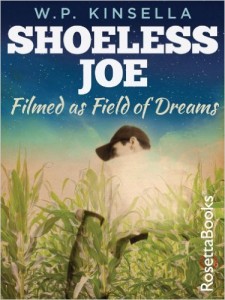
Guest Review: Shoeless Joe by W.P. Kinsella

Today’s guest review is from Laura at 125Pages.com

shoelessjoeThis weeks United States of Books brings us to Iowa with Shoeless Joe by W.P. Kinsella.

2 ½ Stars

Entertainment Weekly says – Not only was this novel – adapted for Field of Dreams – set in Iowa, but Kinsella also attended the state’s other claim to fame: The Iowa Writers’ Workshop.

I went into Shoeless Joe with such hope. I have not seen Field of Dreams, but love uplifting sports movies, so I thought I would love one in book form. But this was no uplifting sports movie, it was a strange tale of a man who builds a baseball field on his failing Iowa corn farm then leaves his wife and small child to kidnap famed writer J.D. Salinger and take him on a road trip. I’m sorry what? Where is my tale of a downtrodden man who has a vision and through that builds his dream on his farm? Instead I get a wacky buddy road trip comedy, complete with carnies and diner hold ups. The action on the farm is limited to the very beginning and the very end, and that is where the heart of the story was. A struggling man trying to save his farm and his family with a dream and pure gumption. Those parts were fantastic, but the rest was just ridiculous.

itsiowaThe plot had its moments, but they were sadly few and far between. The family parts were great, but the whole kidnapping road trip aspect totally lost me. The world created was the same, certain select parts were crisp and vivid, then it veered into crazypants territory. The writing was fine, sentence structure wise, but the story was so over the top I couldn’t really see any fine nuances. The characters were a mashup of amazing and then not, they started strong but then went downhill the more I read. I had no emotional tie to any of the characters. Ray was dismissive of the real world and the potential harm he was bringing to his wife and child.
“God what an outfield,” he says. “What a left field.” He looks up at me and I look down at him. “This must be heaven,” he says. “No. It’s Iowa,” I reply automatically.

Shoeless Joe is considered one of the greatest sports books written. I just didn’t see it. Less a book about baseball to me, and more a book about what too much Round-Up in a field will lead to. I do understand the baseball at the heart of the story and how it linked every part together, but failed to see the amazing parts as the random hostage taking of a reclusive writer and a road trip with said writer to pick up baseball ghosts took away from that for me. As did the husband and father endangering the future of his family by leaving them as their farm is about to be foreclosed on. Now, I don’t hate baseball and I know, national sport and all, but this book just didn’t do it for me.

Favorite lines – Pedestrians in the East behave like lemmings rushing dispassionately to their deaths—it takes a good ten minutes to make a left turn into the blinding rush of oncoming traffic, with pedestrians thronging suicidally into the intersections.

Biggest cliché – If you build it, he will come.

Have you read Shoeless Joe, or added it to your TBR?

Check out all of the #USofBooks posts here.


USofBooksIowa

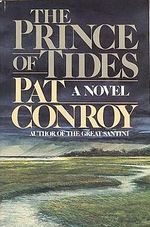
Guest Review: The Prince of Tides by Pat Conroy

Today’s guest review is from H.C. Newton at The Irresponsible Reader

Mixed Rating:
Did I Like It?
★ ★
Did I think it was well-done? (lost a 1/2 star in the last 50 pages or so)
★ ★ ★ 1/2
tides

The story of the Wingos is one of humor, grotesquerie, and tragedy. Tragedy predominates.

So warns Tom Wingo before beginning to relate that story to Dr. Susan Lowenstein. Lowenstein is Tom’s sister’s therapist and needs his help to understand Savannah, who recently tried to kill herself for at least the third time. Savannah’s now institutionalized until she gets back to a place where she can handle her PTSD (my diagnosis, not Lowenstein’s), psychosis, and whatever else they diagnose her with.

As he has done before, Tom has dropped everything and rushed to New York City (from the tiny community of Colleton, South Carolina) to help his sister. The best way to do that, Lowenstein says, is to fill in the large blanks of memory that Savannah demonstrates. Then, she’ll be able to help Savannah remember and move on from whatever trauma has brought her to this stage. Tom agrees — not only has he come to help his sister, he’s also taking a break from home: he’s been unemployed for a year, he just learned his wife is having an affair and might leave him — maybe by helping his sister’s therapist help her, he might get help in the process.

Before he gets the call about his sister and finds out about his wife, Tom’s spending time with his three daughters and jokes with them:

. . .parents were put on earth for the sole purpose of making their children miserable. It’s one of God’s most important laws. Now listen to me. Your job is to make me and Mama believe that you’re doing and thinking everything we want you to. But you’re really not. You’re thinking you own thoughts and going out on secret missions. Because Mama and I are screwing you up. . . I know we’re screwing you up a little bit every day. If we knew how we were doing it, we’d stop. We wouldn’t do it ever again because we adore you. But we’re parents and we can’t help it. It’s our job to screw you up.

That’s not the last time Tom will joke about this, but he’ll spend far more time showing and telling the reader about how parents go about screwing up their kids — he, Savannah and their older brother, Luke, are proof of that (there are four exceptions to this in the novel — but I can’t help but think that with some more investigation, they’d be shown as screwed up, too).

The seeds of this parental function are planted on the night of the twin’s birth, and soon flower while the children are (at least) toddlers — and it doesn’t stop, ever. To detail it would be to give too much away, but Tom, Savannah, and Luke have horrible childhoods and the proof of that is writ large all over their adulthood. Which doesn’t mean that the book is entirely grim — their father has bouts of generosity, of letting his imagination get away from him and getting the family involved in an escapade; they have loving grandparents; they’re successful at school (in differing ways); they adore their mother (rightly or wrongly); they have adventures — they’re actually happy frequently. But then the reality of their poverty, their abusive father, their (I’ll let you fill in the blank if you read it) mother, will revisit them and things will be grim again. Early on, we’re told that something horrible happens to Luke just a couple of years before this most recent suicide attempt, their father is in jail, and that his mother has remarried (to someone Tom hates more than his father). Slowly but inexorably, we march toward those ends. Alternating with the tales of their past, we see Tom in New York, trying to help and understand his sister, as well as the growing friendship between Tom and Lowenstein.

At the end of the day, Lowenstein’s son is the only character that I liked (and maybe Tom’s daughters — but we spend less than ten pages with them, so it’s hard to say). Which doesn’t say a whole lot for the rest of this motley collection of scofflaws, narcissists, manipulators, bullies and gulls. Thankfully, you don’t have to like all the characters to appreciate a well-written, well-structured novel. Which this largely is.

I’m not entirely convinced it’s as good as it thinks it is, however (it, and most readers, it appears). It frequently seems over-written — too much squeezed into a sentence; sentences filled with sesquipedalian words (after paragraphs without any); the humor seems forced sometimes; the dialogue is frequently stilted. The flashback segments appear to be what Tom’s relating to Lowenstein — but I have to wonder if they’re more detailed for the reader than they are for Lowenstein. She complains that Tom’s not forthcoming about the mother (unless maybe his version conflicts with what Savannah has been telling her), because I think I get a pretty clear picture of her from that.

There are some reveals promised early that Conroy doesn’t deliver until towards the end — and he mostly delivers well. However, one of the big reveals (at least Conroy played it as one), was telegraphed so clearly hundreds of pages before I didn’t think it even needed to be mentioned — it could just be assumed. Like he didn’t need to mention that the football coach from South Carolina had an accent. Telegraphing it the way he did made it seem like an authorial or editorial failure. There was one reveal that was promised only a chapter or so before we got it — I’m glad I didn’t have to wait long for it, because of all the things he teased, this was the most vital (and most disturbing) — setting up Savannah’s first suicide attempt and the rest of her life (it seems).

I’m sure I’m in the minority here, but I think the book tries to do too much — especially by the time it gets to the end, where Tom is beginning to tell us the dark thing it’s been hinting at about Luke, the set-up for what happens to Luke was just too much. Conroy covers race, regionalism, psychiatry, feminism, theories of masculinity, how sports can be noble, spousal/parental abuse, marital fidelity, marital love, marital betrayal, sexual assault, school integration post Brown vs. Board of Ed, Vietnam, property rights, the drug war, quixotic faceoffs against the federal government . . . and other things I’m forgetting. It’s just too much — especially to befall one family (even if three generations are in view).

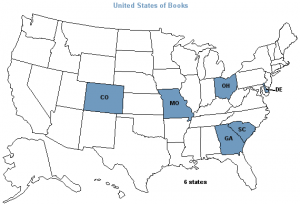
So as part of this United States of Books series, one thing I want to look at is why the book was chosen, what did the novel teach me about the state, why did EW pick it as “the one work of fiction that best defines” South Carolina? It’s definitely not because it paints the residents in the kindest light — the constant contrast between small-town SC versus a fairly idealized New York City (or at least affluent NYC) doesn’t do the state any favors. There’s a sense of a mix of pride and shame about the people, the history, and legacy of the state. The sharp class distinction — not just racial — drove so much of the characters actions and desires that it seems to be part of their DNA (although it can be overcome with the right strategy and dedication). It’s not the best part of the country to live in, the book seems to say, but those who embrace the life, the state, develop a great love that transcends all sorts of regional, intellectual or philosophical chauvinism. Also, I should’ve realized, but didn’t, that there was more to SC coastal industry than tourism, never occurred to me that there might be shrimpers, lobster trappers, etc.

“There’s a difference between life and art, Savannah,” I said as we moved out into the Charleston Harbor.

“You’re wrong,” she said. “You’ve always been wrong about that.”

I knew very little about this book going in. I remembered when I was in college shortly after the movie came out that everyone talked about Conroy as if he were a genius. I knew that the movie (and therefore, probably the book) involved some rough-and-tumble guy and a classy psychologist in therapy (and in bed, based on the movie poster). I’ve seen Conroy interviewed and in documentaries, I knew he considered himself a “Southern Writer” in the tradition of Faulkner, Harper Lee, Flannery O’Connor and James Dickey (his influence is clearly seen). But beyond that, I didn’t know what to expect. I think maybe more than this. I have to give this a mixed review — there’s a lot to admire here, scope, character, the way he told a multi-layered story about very familiar subjects in a way that (mostly) didn’t seem to tired or cliché. But, oh, I spent a lot of time hating this book. There were at least two times, maybe three, that I almost walked away from this — and I probably would have if it wasn’t part of this series. I’m not entirely sure that I’m glad I finished.

USofbooksSouthCarolina