“Our physiognomies were ageless. There were wild, unfocused eyes, silent, indrawn lips, and haggardness around the cheek and neck . . . only defined and exaggerated by hunger.” (Page 49)
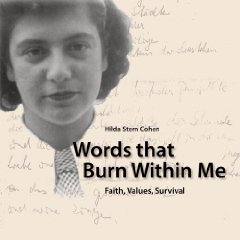
This harrowing story follows Hilda through her early years in Nieder-Ohmen, Germany, and her transfer to schools in Frankfurt as the Nazis gained power. From Frankfurt, she is transported with her family and young beau Horst to Lodz, Poland, only to face devastating circumstances, the loss of Horst, and more and be transported to Auschwitz. In a series of essays and interviews, Hilda talks about happier times in her village and with her sister, the trials of childhood and being bullied, but soon the reality of politics sets in and her family is forced to leave their ancestral home.
Forced Labor (Page 54)
My numbed brow drops on the machine,
I fold my captive, tired hands.
A dangling yellow bulb sheds smoky light,
Dusk falls, the day grows pale.
The harried working hours are almost done,
The evening mist is waiting to embrace us.
What binds us in our common chains
Will only hold us while we work —
Night will find each of us in separate gloom.
Cohen’s writing is sparse but detailed in its observations of those around her in the ghetto and the concentration camps. Her keen eye examines the impact of starvation on her fellow neighbors and on her family members, and it also sheds light on how well her family and herself cope with their situation. She eventually teaches herself Yiddish after joining a literary group because she only speaks and writes German, which is not what the majority of the Lodz Ghetto understands. Readers, however, will note a sense of detachment in her writing, almost as if she is reporting the events as she observed them rather than as she felt them. On the other hand, they will hear the anger and disappointment in her voice, especially when she speaks of the last words her father utters about her mother upon her death.
“There was a strange role reversal that took place psychologically, as it did also later in the camps. Adults who had lived a life from which they had gained certain expectations were suddenly confronted with an abyss. There were no signs, no gateposts, none of the usual milestones that one could follow. Everything had fallen away.” (Page 33)
Words That Burn Within Me
 is well assembled mixture of interviews with Hilda Stern Cohen’s essays, stories and poems. While the collection does illustrate one Jewish woman’s journey during WWII and the Holocaust, it stands as a testament — a record — of how inexcusably these humans were treated and how their debasement impacted their lives, their relationships, their faith, and their souls. Through well tuned description and controlled emotions, Cohen takes the time to record everything she saw during the war and the Holocaust to ensure that it becomes a warning to others. A powerful collection and a must read for anyone learning about this time period and the horrors that should never have happened.
FTC Disclosure: I purchased my copy of Words That Burn Within Me from The Writer’s Center following a reading by Hilda Stern Cohen’s husband and her interviewer Gail Rosen. Clicking on image and title links will bring you to my Amazon Affiliate page; No purchases necessary.