Quantcast

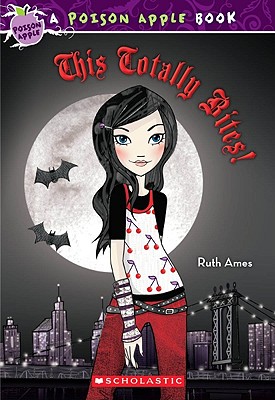
This Totally Bites! by Ruth Ames

This Totally Bites! by Ruth Ames, part of the Poison Apple series of books from Scholastic, is for children in grades 4-6, though it would more likely appeal to girls.  Emma-Rose Paley turns 12 and her life becomes something out of a fantasy novel, and readers will have to suspend disbelief, which shouldn’t be too hard with kids who haven’t lost touch with their imaginations.  Emma likes things dark and wears black, she likes the rain, and she loves rare meat, but her friend Gabby is her polar opposite, wearing pastels, always punctual, and a vegetarian.  In typical seventh grade fashion, there is gossip, hiding from the popular crowd, and navigating peer pressures, but Em’s mother is a curator at the New York Museum of Natural History and her great-aunt is staying with them while helping out with a museum exhibit on bats.

Despite her recurring nightmare of darkness and red eyes, Em tackles her homework and navigates the preteen world with a sense of self unlike most 12-year-old girls.  She’s got her small network of friends, but really only one strong girlfriend, Gabby, while her other two friends tend to waver at the first sign of peer pressure.  In many ways, this dynamic group resembles the truth of school-age kids.  Ames has created a believable world, and even the supernatural elements are believable as the girls research the truth of the matter.  It’s great to see Em come out of her shell, voice her opinion, and become a peer that others can look up to, even when she’s hoping to fade into the background.

There are school girl crushes, bickering, and boy gossip, but what makes Ames’ story memorable is the character of Em, who demonstrates a mature ability to think logically about her situation and at the same time remain vulnerable and stubborn when it comes to arguing her point with her friends.  This Totally Bites! by Ruth Ames is a fun story that younger girls will enjoy and learn about how to be themselves in a world that thrives on peer pressure and fitting in.

About the Author:

Ruth Ames is the author of This Totally Bites, one of the inaugural spine-tingling Poison Apple books. She has written several best-selling young adult novels under another name. Ruth loved reading spooky stories as a child. She now lives in Manhattan.
This is my 5th book for the 2013 New Authors Challenge.

Wonderstruck by Brian Selznick

Wonderstruck by Brian Selznick is a quick read even at 600+ pages, and is a middle grade novel that pairs words and images to tell a heartfelt story of family, discovery, and understanding.  Ben, who has one good ear, has lost his mother in a car accident in 1977 Minnesota and is thrust into his aunt’s home with his cousin Robby, who isn’t too keen on sharing his room.  Ben by all accounts is a curious and shy boy, whom his mother showered with love and attention, encouraging him to scavenge for mementos along the way, which he kept in his museum box.  The loss of his mother weighs heavily on him, and upon discovering his other cousin, Janet, in his mother’s room, he decides to remain behind and feel closer to her.

Meanwhile, Rose’s story is told in drawings set in New Jersey and New York City.  The narration shifts from the present (1977) and Ben’s story to Rose’s story in 1927.  Their stories parallel one another at various points after Ben makes the fateful decision to run away to find the father he has never known.  Wolves, nature, and the Big Apple loom large in both stories as Ben and Rose make their way into the unknown.

Selznick’s prose has an easy flow between the illustrations and the text, and given that both stories are told in separate mediums, it is easy for younger readers to keep them straight. Most readers will note the parallels in the two stories and likely will uncover the final destination long before the last page is turned. The illustrations are detailed in some cases, but there are moments where the illustrations seem to be just filler pages to increase the suspense associated with Ben’s story of self-discovery. Rose’s story could have been told in fewer pages and more sparsely spaced throughout the book and the connections would still have been present.

“The curator then must decide exactly how the objects will be displayed.  In a way, anyone who collects things in the privacy of his own home is a curator.  Simply choosing how to display your things, deciding what pictures to hang where, and in which order your books belong, places you in the same category as a museum curator.” (page 98-9)

Additionally, readers may find that they wanted more about the teasing Ben endures as a boy with only one good ear and who does not know sign language, as well as more about Rose’s story as a young deaf girl in the late 1920s who is sheltered a little too much by her parents.  However, Selznick doesn’t always need a pencil to paint a picture of readers, especially when he can do it so well with words.

“Jamie came and sat next to him as the sky filled with shooting stars.  The projector rotated, the view changed, and the boys found themselves inside a meteor, hurtling across the sky.  They flew to the moon and bounced between craters.  One by one, the planets drifted into view, and soon they were out beyond the solar system, gazing down on the universe like ancient gods.  Ben thought of the glow-in-the-dark stars in his room, and the Big Dipper, and the quote about the stars, and his mom.  The glowing lights above him spun and swirled, tracing endless patterns against the perfect dome of the ceiling like a million electric fireflies making constellations in the dark.”  (page 406)

Wonderstruck by Brian Selznick definitely will appeal to younger readers and illustrators, but it should not be discounted as a fluffy YA novel.  There is a deeper message about finding one’s place outside your own family, about discovering new places and wonders, and about finding the courage to take chances.

What the Book Club Thought (beware of spoilers):

Wonderstruck was the selection of our youngest member, The Girl from Diary of an Eccentric. She prepared discussion questions ahead of time to see what everyone thought of the entire book, the way the two stories were told, and whether anything surprised us. We also discussed what each of us would put in our own museum boxes, and answers ranged from coin collections and shells to Red Sox and Patriots stuff to pictures, stuffed animals, and other sentimental items.

We had an interesting discussion about the “Captain Obvious” nature of some of the prose (The Girl’s words, not ours), and about whether who Rose was or how the stories came together surprised any of us. Most of us were not surprised to find out who Rose was, but I was surprised to learn who Walter was. Many of us agreed that Rose’s ability to cut up a book for the deaf and create a paper replica of NYC was fantastic, and I particularly liked how one of the buildings she made had the picture of the mouth on it from the book. One of the male members liked elements of the story individually, but not how they came together as a whole. Overall, it seemed like most of us enjoyed the book, though two members were absent from the discussion this time around.

Next month is my selection, When She Woke by Hillary Jordan, and one of our members has already finished it and is itching for discussion.

About the Author:

Brian Selznick is the illustrator of “Frindle” by Andrew Clements, “Riding Freedom” and “Amelia and Eleanor Go For A Ride,” both by Pam Munoz Ryan; as well as his own book “The Houdini Box,” winner of the 1993 Texas Bluebonnet Award. Mr. Selznick lives in Brooklyn, New York.


This is my 47th book for the New Authors Reading Challenge 2012.

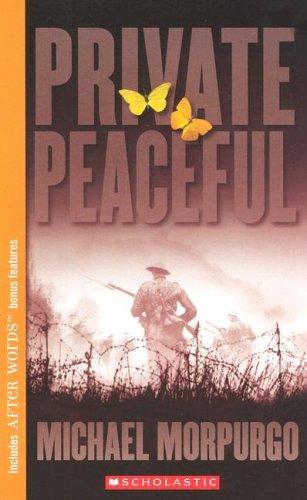
Private Peaceful by Michael Morpurgo

Private Peaceful by Michael Morpurgo is a coming-of-age novel (grades 7 and older) that sets readers up for the dreary and devastating life of a young boy, Tommy Peaceful, whose father dies unexpectedly at work as a forester.  Tommy and his brother Charlie are inseparable, and their other brother Big Joe has special needs and is often protected by the family whether it is in the school yard or at home from their Great Aunt.  Tommo tells the story in a series of flashbacks about his father’s death, his regret about how it happened, his friendship and kinship with his brother Charlie and their schoolmate Molly, and The Great War that invades their lives.  Readers will not immediately grow close to Tommo in the beginning, but as he opens up about his past and present situation overseas, it is revealed that things have changed far more and far too quickly for him.  He’s fallen in love, rushed to become an adult, and headed off on an adventure that was far less exciting and far more harrowing than he expected.  Each chapter begins with a little snippet of his present situation before Tommo relives his past happinesses, until the two moments meet in time.

“I want to try to remember everything, just as it was, just as it happened.  I’ve had nearly eighteen years of yesterdays and tomorrows, and tonight I must remember as many of them as I can.  I want tonight to be long, as long as my life, not filled with fleeting dreams that rush me on towards dawn.”  (page 1)

Morpurgo is at his best here with the subtle foreshadowing at the beginning with the crows caught in the fence, like the cavalry caught in the barbed wire of the battle fields and throughout in how Tommo relates his story.  He was 15 when he enlisted in the British military, but only after Charlie agreed to lie for him and say that they were twins of the same age.  These devoted brothers have shared everything — the sorrow of losing a father, the sorrow of losing a dog, the joy of finding Big Joe alive, and the love of Molly — but sharing everything also can breed secrets and resentment, which Tommo brings to the forefront when he speaks of Molly.  From the beginning, readers are given a clear picture of Tommo’s devotion and love for Molly, but it is clear that she treats him more as a sibling and he refuses to see it.

“Every uniform and every helmet was like our own.  Then, as we came down the gangplank into the fresh morning air, we saw them, the lines of walking wounded shuffling along the quay toward us, some with their eyes bandaged, holding on to the shoulder of the one in front.  Others lay on stretchers.  One of them, puffing on a cigarette between pale parched lips, looked up at me out of sunken yellow eyes.  ‘G’luck lads,’ he cried as we passed.  ‘Give ’em what for.’  The rest stayed silent and their staring silence spoke to each of us as we formed up and marched out of town.”  (page 115)

Morpurgo’s prose is clear and concise to ensure the mood is vivid and the experience of first person has the full impact, particularly during training and in the trenches.  A bit more for maturer audiences with its focus on the war and soldiering, but there are lighter moments of ribbing between the soldiers and talk of girls and even romance.  However, Private Peaceful by Michael Morpurgo is more about a young man coming into his own and dealing with the decisions he’s made and the events he’s witnessed.  Tommo has not only a colored past of poaching and death, but also a soldiering present that has tested his courage and devotion.  An excellent introduction to The Great War.


This is my 2nd book for the WWI Reading Challenge.

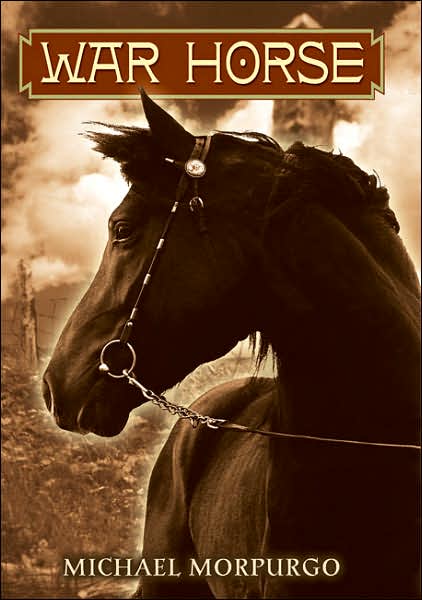
War Horse by Michael Morpurgo

War Horse by Michael Morpurgo is told from the point of view of the horse, who is sold at auction to a drunken farmer and is written for a younger audience, grades 5-8.  In this coming of age story, the young boy Albert Narracott and his Red Bay Joey grow up together and the bond they create lasts through a number of obstacles.  Joey is sold and is off to war — The Great War — to work as a cavalry horse.  Like soldiers in war, Joey must learn maneuvers and be conditioned to fight, which really translates into unlearning farm work and learning how to get his rider safely through the enemy lines.  Morpurgo takes Joey and his readers on a harrowing journey through France where much of the battles take place, and like soldiers, horses were captured as prisoners of war.

“All around me, men cried and fell to the ground, and horses reared and screamed in an agony of fear and pain.  The ground erupted on either side of me, throwing horses and riders clear into the air.  The shells whined and roared overhead, and every explosion soon seemed like an earthquake to us.  But the squadron galloped on inexorably through it all toward the wire at the top of the hill, and I went with them.”  (page 59)

The anthropomorphism of Joey is stunning in this novel.  Morpurgo really understands how to create an animal character who seems more like a human being.  Joey struggles with war fatigue, fear, loss, and a whole set of other emotions, but while away from Albert, he holds onto the love and comfort of his farm life.  Along the way he is treated well and mistreated.

“I found Topthorn was always by me and would breathe his courage into me to support me.  It was a slow baptism of fire for me, but without Topthorn I think I should never have become accustomed to the guns, for the fury and the violence of the thunder as we came ever nearer to the front line seemed to sap my strength as well as my spirits.” (page 44)

What more could readers ask for in a young readers novel about WWI?  A champion horse who earns an Iron Cross and saves his riders from certain death, but who fears and loves just as the young boy he knew did, just as everyone does.  Joey is a hero in more ways than one, and his courage is something that all young readers could learn from, especially how Joey overcomes his fear of strange lands and people.  Additionally, he strives to do his best even when he doesn’t want to do what the humans have him doing and even though it is painful to go on without food and shelter.  Survival is paramount, and Joey not only looks out for himself and his riders, but he befriends and cares for other horses in the regiments.

War Horse by Michael Morpurgo is stunning and engages readers early on in the struggles of a young horse who is taken from his home and thrust into WWI in 1914.  There are images of war, but there is nothing too gruesome that parents should worry about young readers.  On more than one occasion, readers will be moved, and chests will be full of emotion and tears will well in their eyes as Joey relates his story.  A great way to learn about the harrows of war without delving too deeply into the politics or military strategy, while at the same time demonstrating its far reaching impacts on non-military personnel, soldiers, and horses.

This is my 1st book for the 2012 New Authors Challenge.


This is my 1st book for the WWI Reading Challenge.


Mockingjay by Suzanne Collins

Mockingjay by Suzanne Collins is the third book in the young adult Hunger Games trilogy featuring Katniss Everdeen, Peeta, and Gale.  Readers have been raving about the series, and many are obsessed with the Peeta-Katniss-Gale love triangle.  (You can read my reviews of the previous two books, The Hunger Games and Catching Fire — IF you have not read the previous two books, be warned that this review will be full of spoilers).

Katniss has been rescued by the rebel alliance of District 13 — thought to have been destroyed by the Capitol — but Peeta was left behind to be captured by President Snow’s forces.  Beyond deciding whether or not to become the symbol — the MOCKINGJAY — of the rebellion, Katniss must further realize that she needs to make adult decisions, decisions that could impact the fate not only of the rebels, but of the human race.  Along the way, she will reconnect with Gale, her family, Finnick, and others from the Games, but she also will be hit hard by the tragedy of loss, even those losses she was too numb or too blind to notice when they occurred.  As part of her evolution, Katniss must learn to discern for herself the best course of action and how her actions impact others, as well as how each side is manipulating every move she makes.

“After about twenty minutes, Johanna comes in and throws herself across the foot of my bed.  ‘You missed the best part.  Delly lost her temper with Peeta over how he treated you.  She got very squeaky.  It was like someone stabbing a mouse with a fork repeatedly.  The whole dining hall was riveted.'” (page 244)

Collins has a firm grasp of how a young teenage girl would react to high levels of danger, betrayal, and dystopian heartbreak.  Her no-nonsense prose keeps the plot moving quickly and easily paints a picture that young and adult readers become lost in.  Time flies quickly as readers get absorbed in the rebellion, cheering on Katniss and her struggle to find her rightful place.  However, there are moments when the reader will want the plot to move more quickly or will want more action or will wonder why Collins is beating them over the head with the references to the oppressive nature and rigidity found in District 13.  At one point, it seems that the narration takes on a preachy tone as the benefits of democracy are heralded above the current, rationing-and-sharing government of District 13 and the power wielded by the dictatorship of the Capitol.  However, readers will easily forgive this digression as the action picks up once again.

What’s ironic about this third book is that Prim, Katiniss’ younger sister, seems more mature, while Katniss is still childlike and impulsive.  Prim seems to have matured in a way that Katniss, who has seen more violence, could not — perhaps because Katniss’ childhood was a place she could retreat to and feel safe.  Prim’s character development is not spelled out, but readers are likely to enjoy the new dynamic between her and her sister.  A number of secrets about the Capitol and what happened in District 13 are revealed, rounding out the trilogy.  Compared to the other books in the series, Mockingjay does not have as much action, but overall, it is a satisfactory end to this dystopian trilogy.

This is my 9th book for the 2011 Wish I’d Read That Challenge.  I’ve wanted to read this since I pre-ordered the book from Amazon.  It’s about time I read this one.

Fallen Angels by Walter Dean Myers

Fallen Angels by Walter Dean Myers is a young adult novel for ages 9-12 or ages 12 and older depending upon maturity.  It touches upon the role and racism encountered by young African-American draftees and volunteers in the Vietnam War.  The coming-of-age novel was banned by certain school districts for its use of profanity, violence, sexual language, and vulgarity, and continually challenged by parents and teachers for the last decade.  Myers pulls no punches in this young adult novel, painting a picture of war as teens drafted in the 1960s would have experienced it and been impacted by it.

Harlem, New York’s Richie Perry volunteers to join the army at age 17 after he realizes its the best option to provide for his alcoholic mother and younger brother and that college is a dream that is too far out of reach since his father abandoned them.  He joins Alpha Company once in Vietnam and meets a cast of characters from a soldier who preaches faith to Peewee who acts as tough as he does on the Chicago streets and sees racism in every comment.

“Hot.  Muggy.  Bright, Muggy.  That was the airport at Tan Son Nhut.  We deplaned, followed Lieutenant Wilson across the field into an area in front of some Quonset huts, and started forming ranks.  It took a while.  The sergeant with the clipboard came along and tried to encourage us as best he could.

‘You faggots can’t even line up straight, how you gonna fight?’ he shouted.” (page 7)

Perry thinks a lot about what to write to his mother and his brother, Kenny, and he details every moment of his time in Vietnam as if he’s keeping a journal.  His relationship with Peewee continues to grow even though their outlooks on getting back to the World differ and their reactions to tragic events are opposite.  Death touches these men in many ways, but mostly they try to forget despite the visions that flit in front of their minds out in the field as they fight the Viet Cong.

“‘How about people in the hamlet?’ Brew asked.

‘We got to show them that we can be peaceful if they peaceful with us, or we can mess them up,’ Sergeant Simpson said.

‘Pacify them to death!’ Peewee said.”  (page 120)

Fallen Angels tackles very adult themes, but from the point of view of young teenagers thrown into a war they do not understand, are unable to describe to their loved ones, and have a hard time dealing with on a day-to-day basis.  How do you define courage? Can killing the enemy and seeing fellow soldiers die be forgotten and should they?  From the spider holes used by the Viet Cong in their guerrilla warfare against the Americans to the miscommunications and changed orders for each unit, Fallen Angels provides an inside look at this confusing war, and sheds light on how inexperienced soldiers react when facing death and superiors they do not understand.  Walter Dean Myers tackles not only morality, but also racism, courage, forgiveness, and finding oneself amidst terrifying circumstances.  The anniversary edition includes information about the author and some book club discussion questions with answers from the author.

About the Author:

Walter Dean Myers is a writer of children’s and young adult literature. Walter Dean Myers was born in West Virginia in 1937 but spent most of his childhood and young adult life in Harlem. He was raised by foster parents and remembers a happy but tumultuous life while going through his own teen years. Suffering with a speech impediment, he cultivated a habit of writing poetry and short stories and acquired an early love of reading.


This is my 53rd book for the 2010 New Authors Reading Challenge.


This is my 10th book for the 2010 Vietnam War Reading Challenge.